 S3 Enterprise
48 screens
Items
The stores: every item, how much of it is where, and every movement in and out. Every page in the Items menu, what it is for, and where it leads; then the main records, tab by tab. The pictures are the demo company (Foundry Valves) after the test runs, so the names and numbers are made up. For the story of the stores, read How the stores work first.
How stock moves
Every movement is a document, posted once: stock goes up or down by it, its value with it, and the books follow. A posted movement is never edited - it is cancelled, and the stock goes back.
The work
Items - what we hold
Items
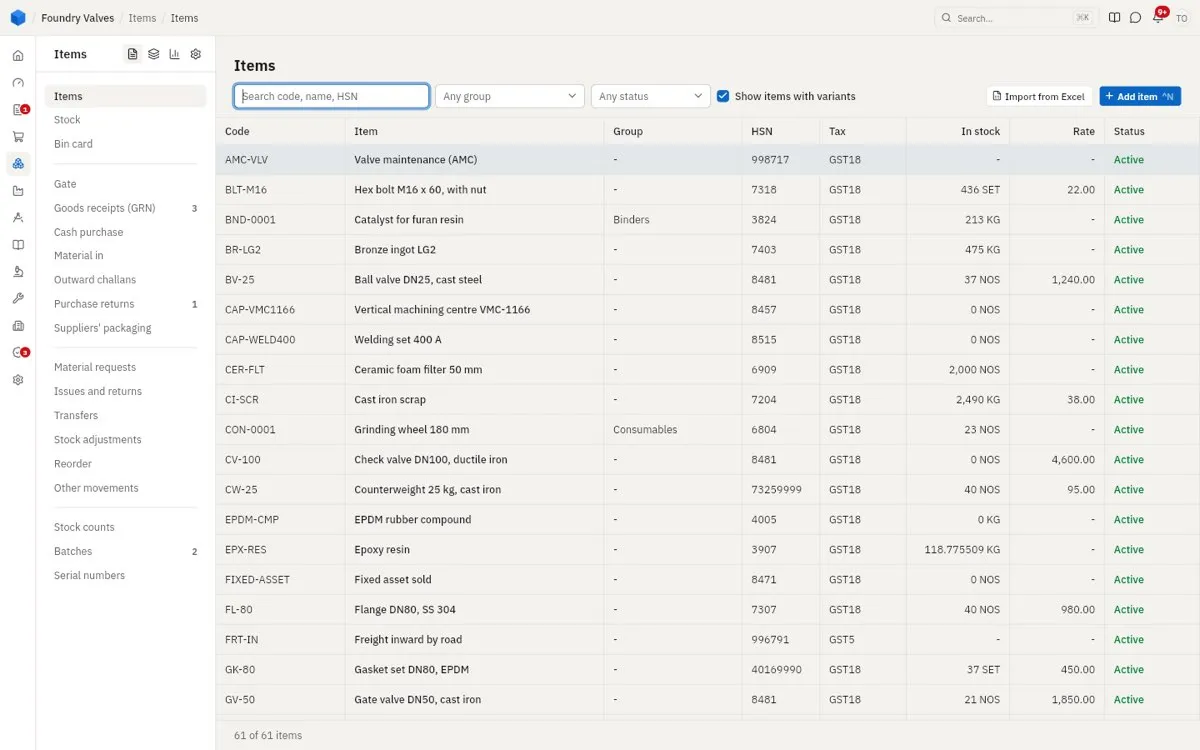
Everything the company buys, makes, sells or keeps: its code, name, group, HSN and tax, how much is in stock and its rate. Import from Excel brings a list in. An item with variants (sizes, materials) is one item per combination.
Stock
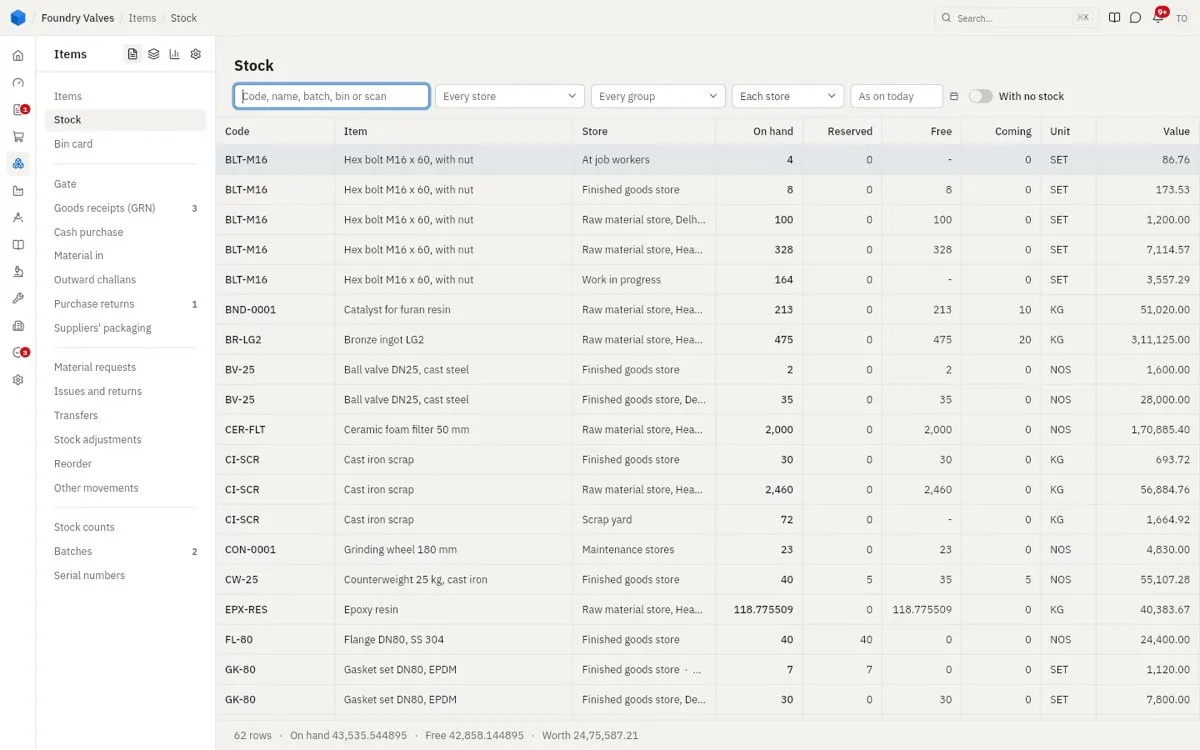
How much of each item is in each store right now: On hand, Reserved (held for an order), Free (on hand less reserved), Coming (ordered, not yet in) and its value. Search by code, batch, location, or scan a barcode. As on shows any past date.
Bin card
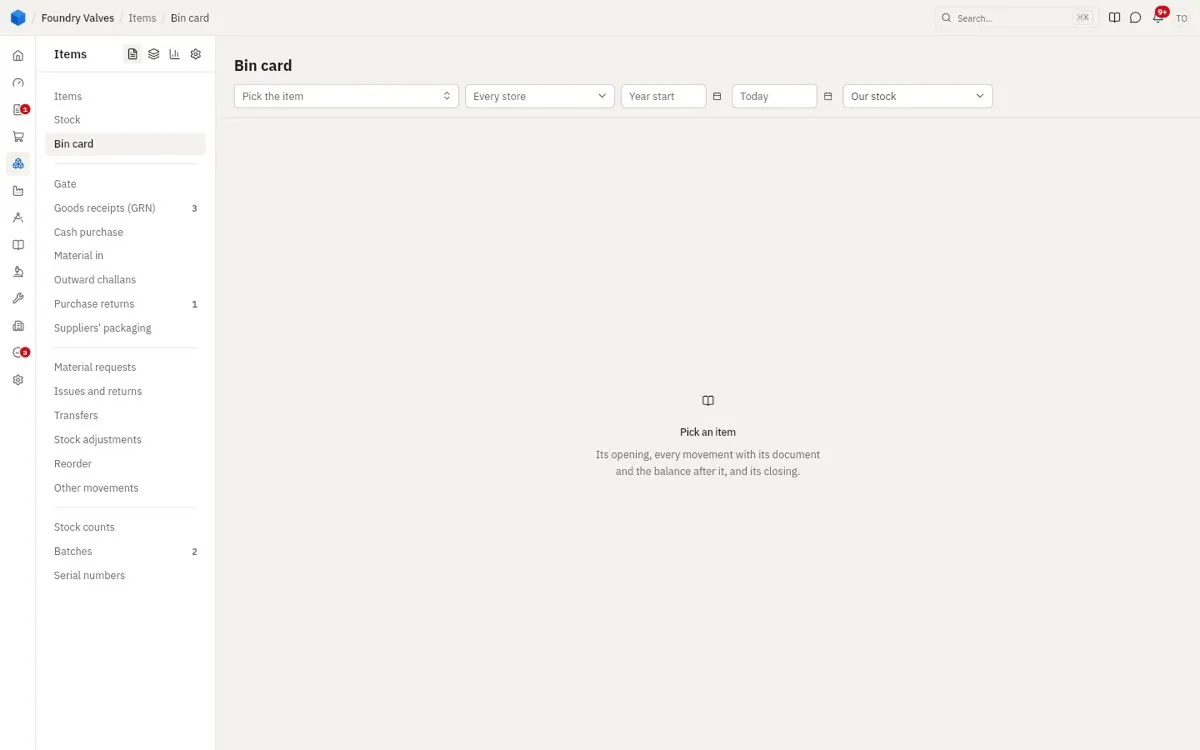
One item's story in one store: the opening, every movement with its document and the balance after it, and the closing - the stores' ledger.
Gate and receiving
Gate
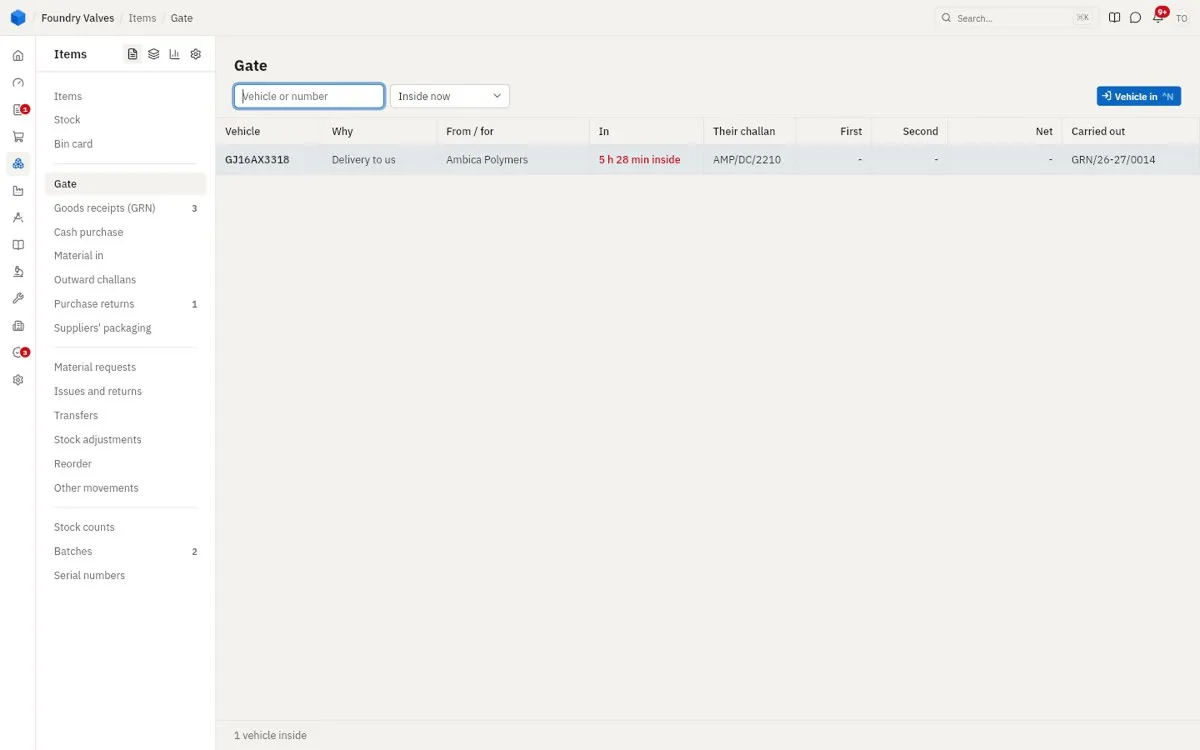
Vehicles in and out of the gate: why they came (a delivery to us, a pickup), from whom, their challan, the weighbridge weights, and the document they carried out. A vehicle inside too long shows in red.
Goods receipts (GRN)
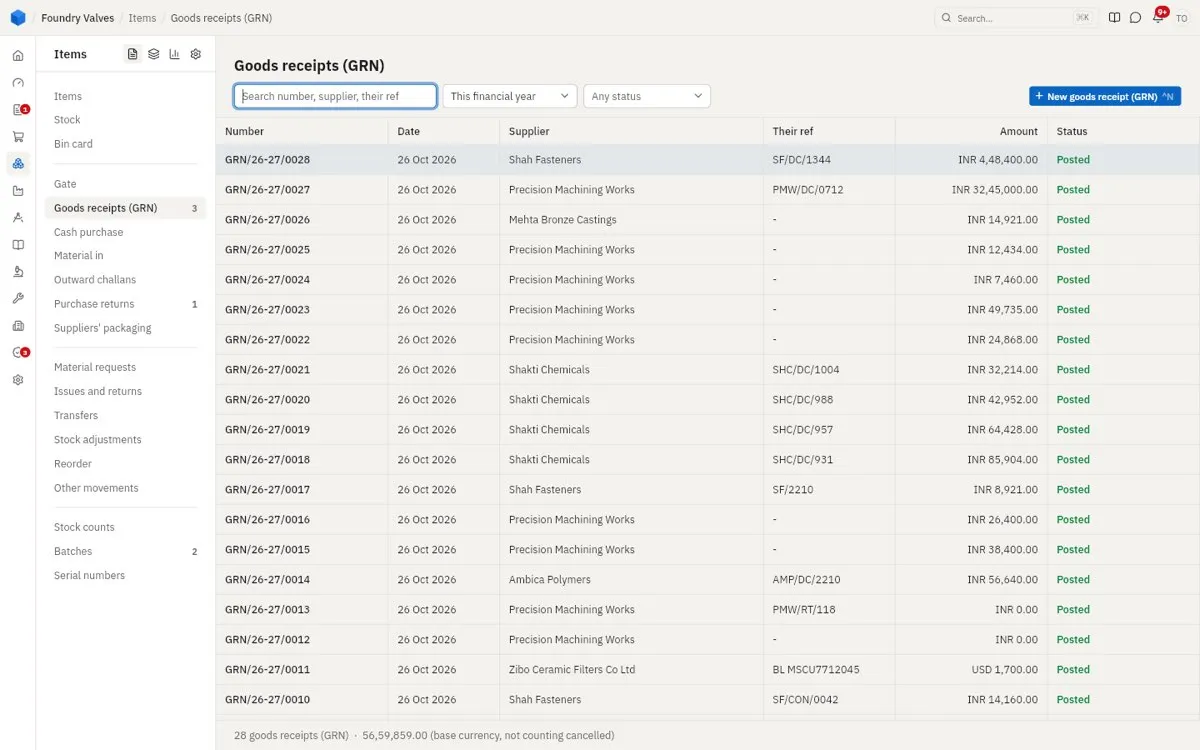
Goods received from a supplier against their purchase order: how many came, how many were rejected, into which store, with their batch or heat number and serials. Posting it puts the stock in (or into quality hold first). Leads to: the supplier's invoice.
Cash purchase
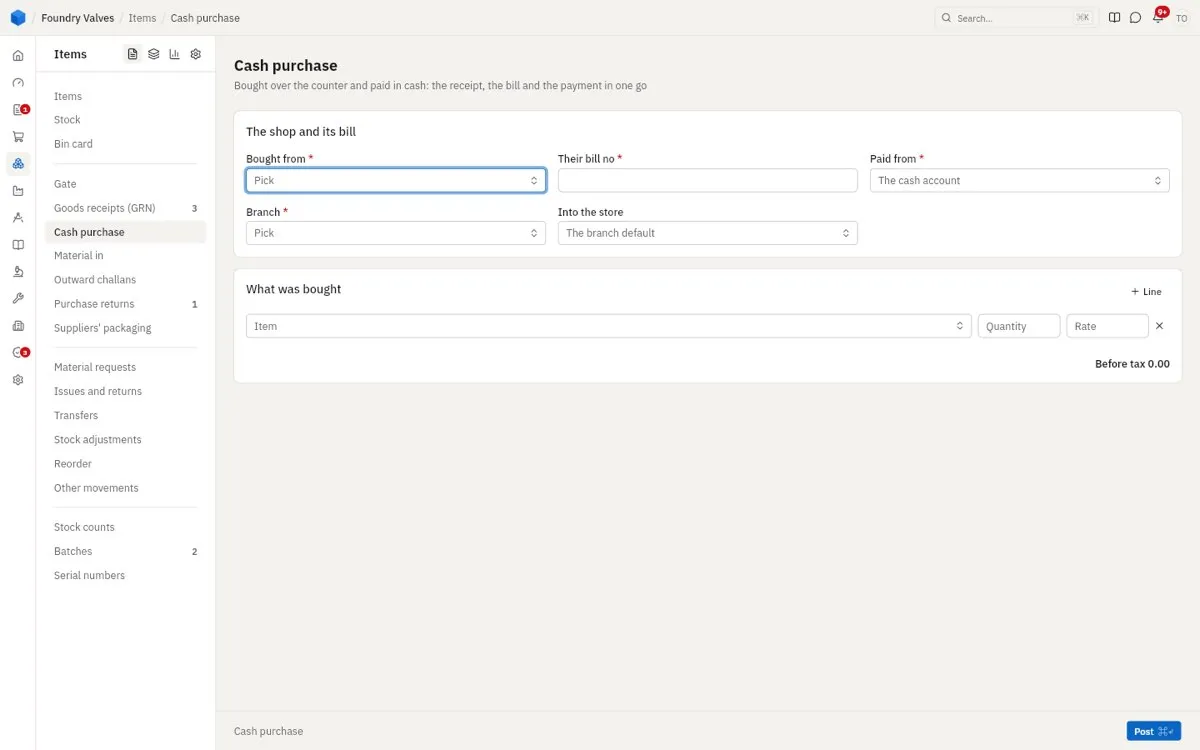
Something bought over the counter and paid in cash: the receipt, the bill and the payment in one go.
Material in
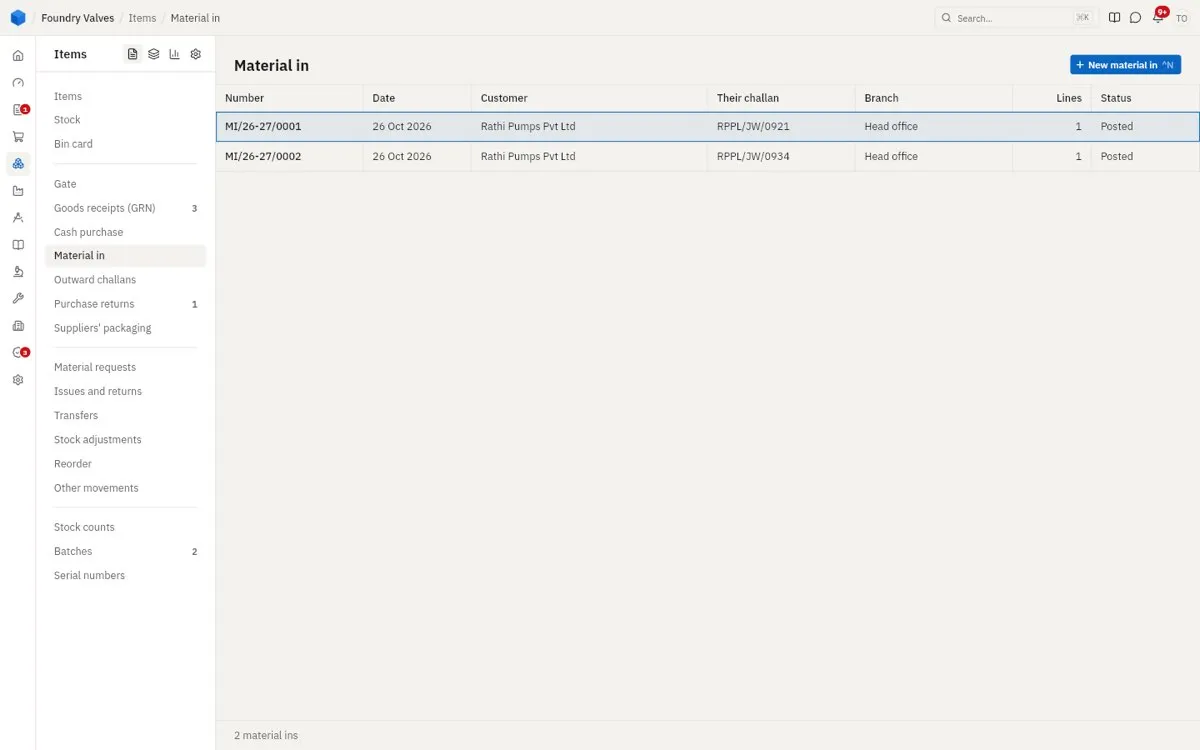
A customer's own material come in for us to work on (job work for them). It is theirs, so it is counted apart from ours.
Outward challans
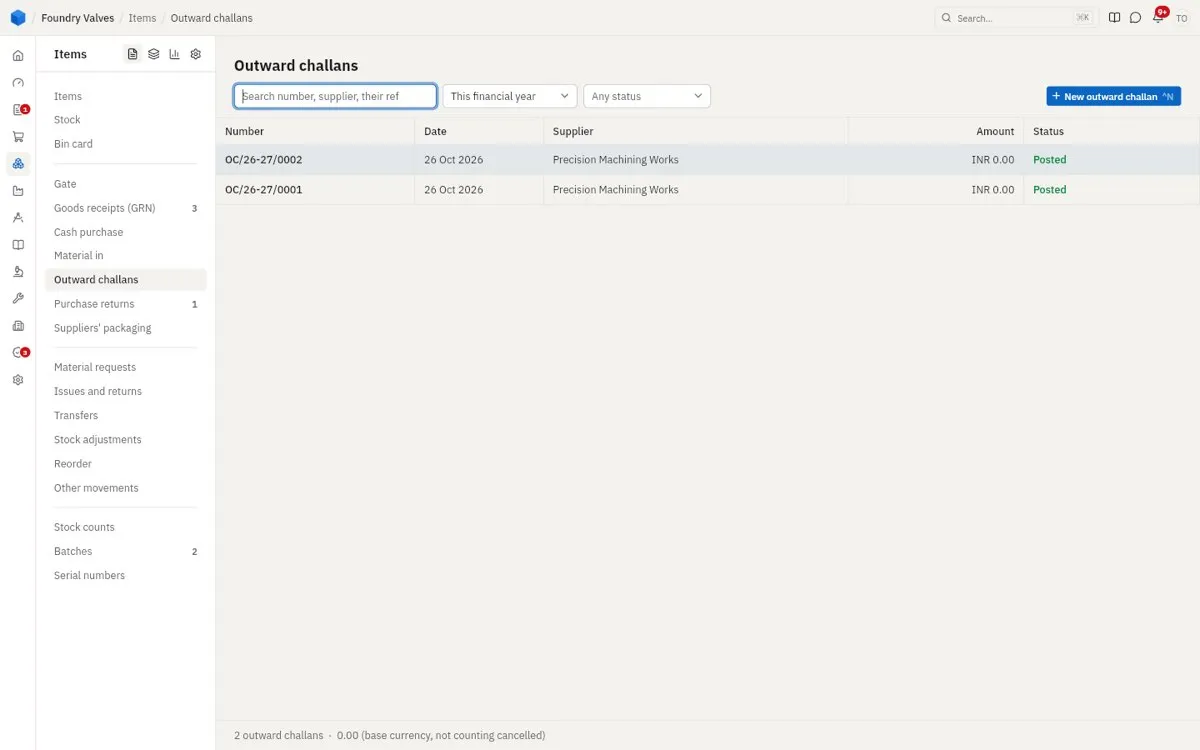
Material that goes out without being sold: for repair, for a trial, on loan. A returnable one is waited for until it comes back.
Purchase returns
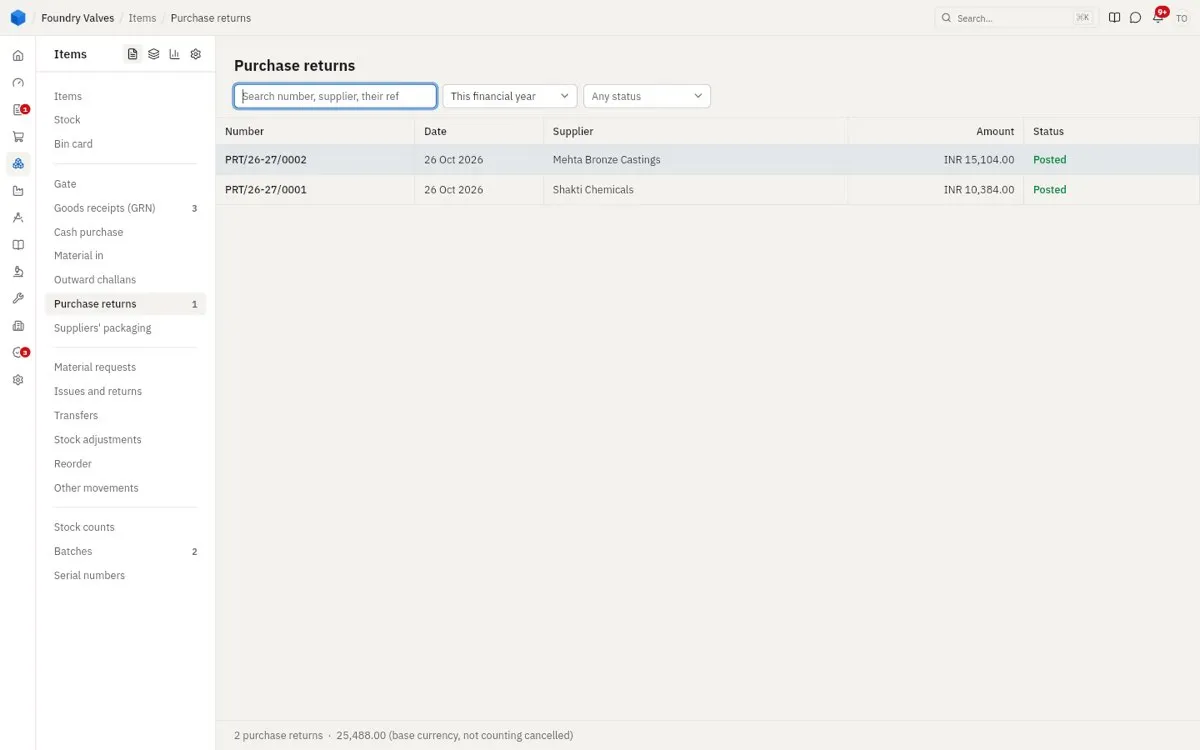
Goods sent back to a supplier - rejected at inspection, wrong, extra. Leads to: a debit note.
Suppliers' packaging
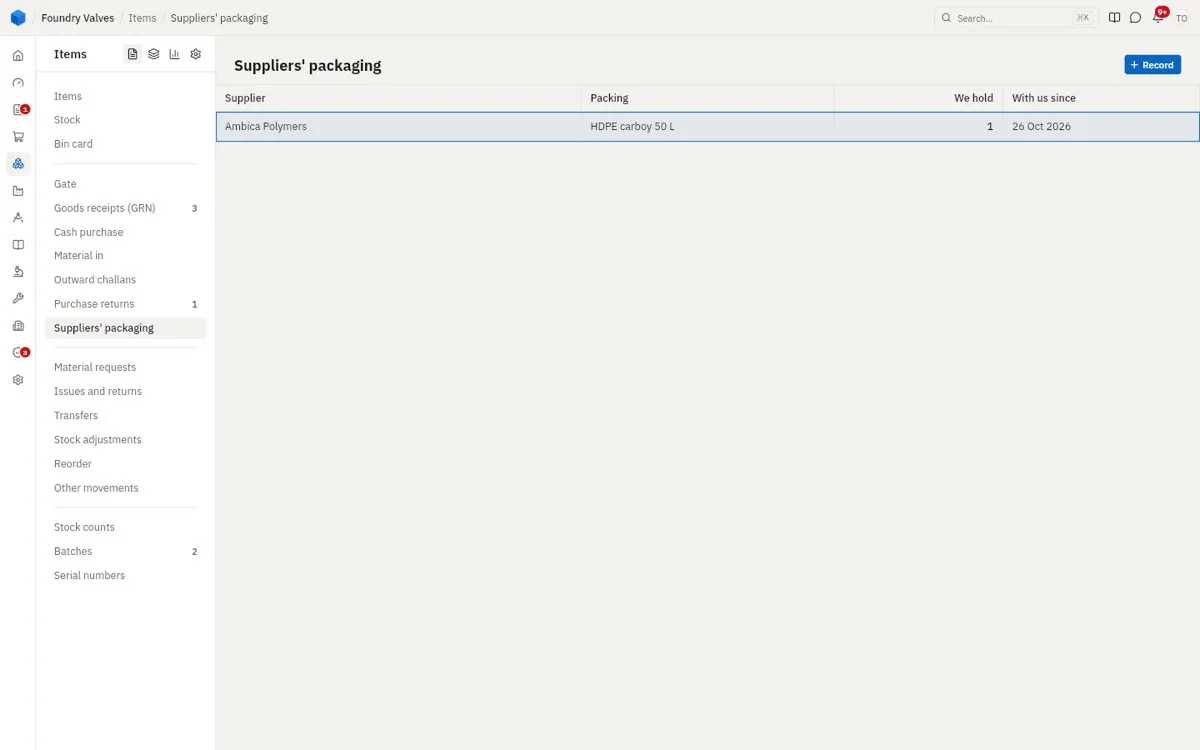
A supplier's returnable packaging with us - gas cylinders, drums, pallets - and what has gone back to them.
Moving
Material requests
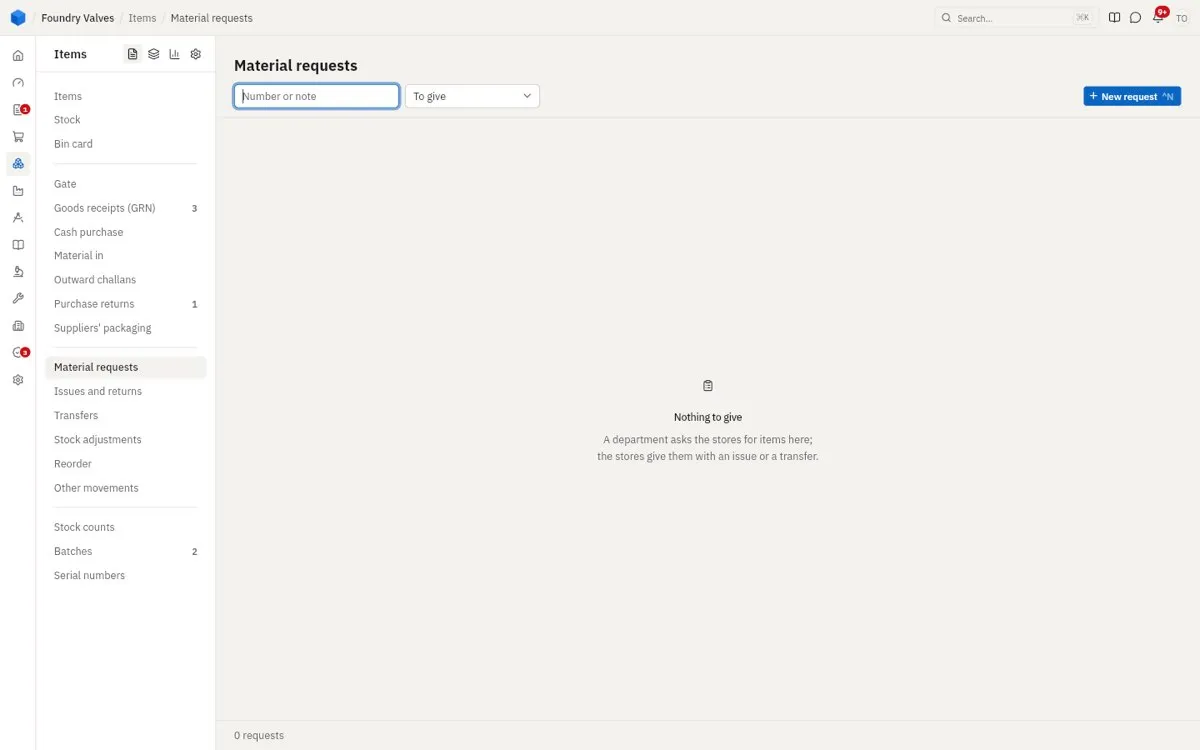
A department asks the stores for items ("6 grinding wheels for maintenance"); the stores give them with an issue or a transfer. To give shows the ones waiting.
Issues and returns
Stock given out of a store to a department, a machine or a work order, and what comes back unused. Its cost goes to whatever it was issued to.
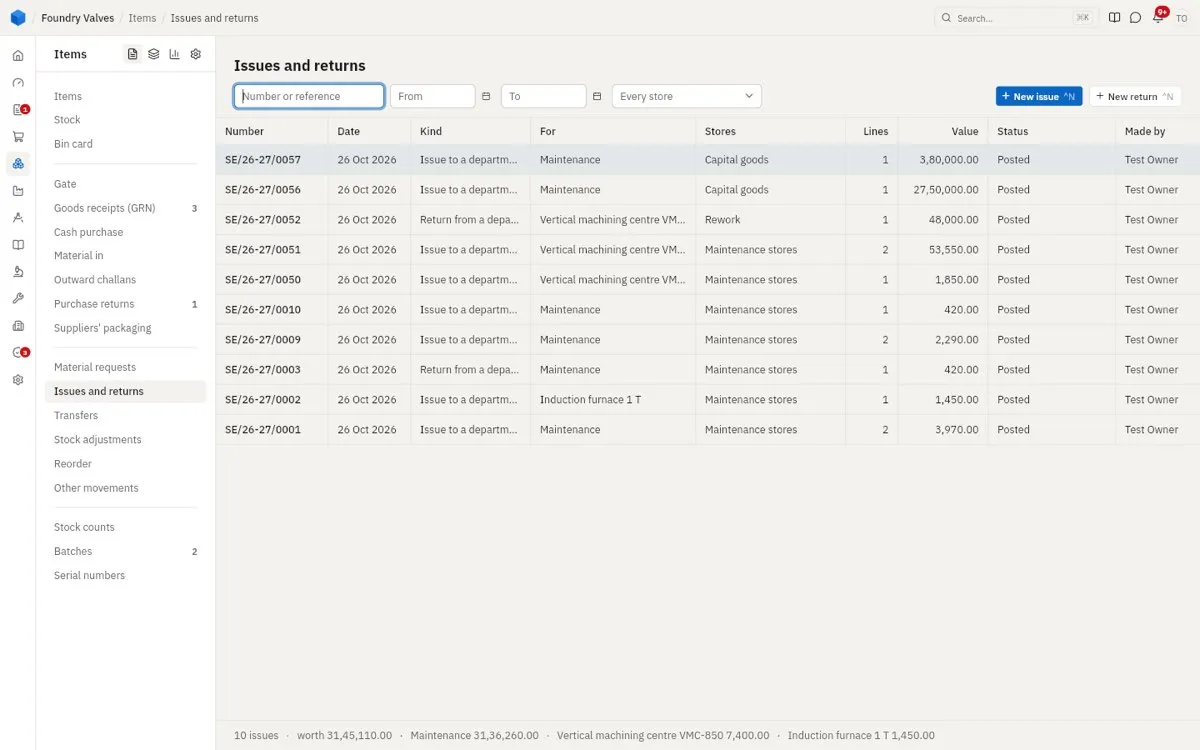
Transfers
Stock moved from one store to another - within a plant, or to another plant (it is in transit until it arrives).
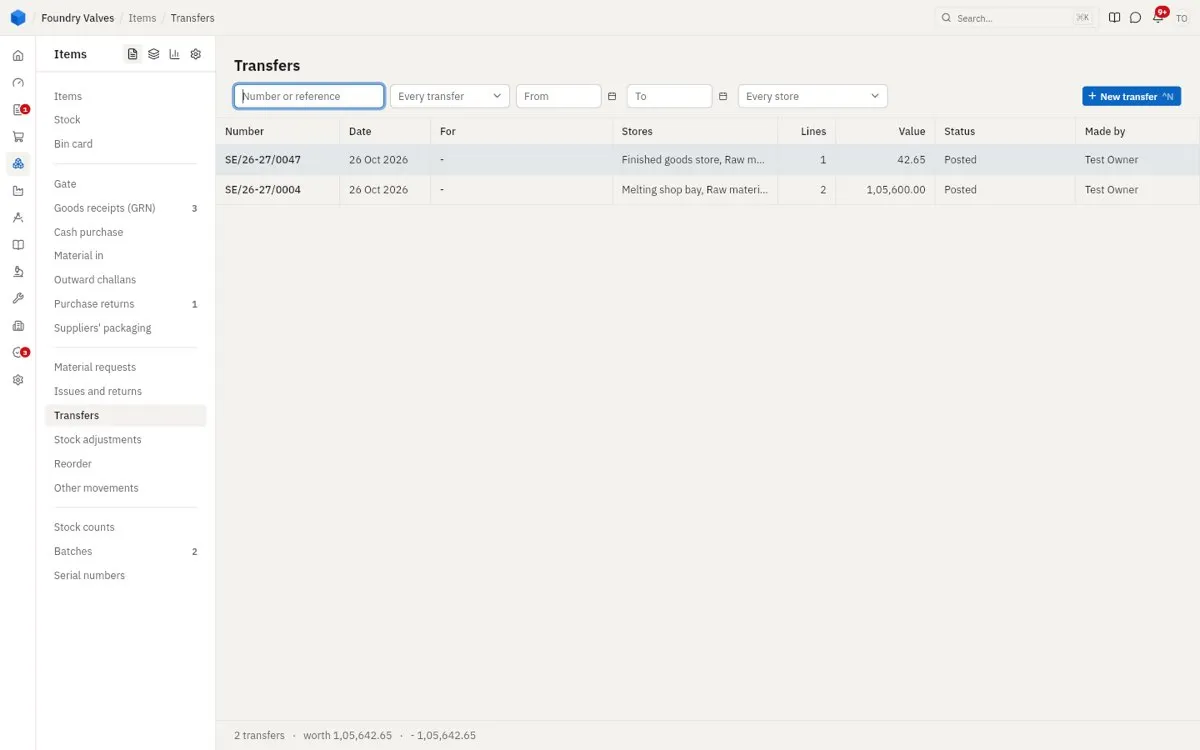
Stock adjustments
Stock put in or taken out with a reason and no other document: opening stock, found, damaged, expired, lost. The foot totals each reason.
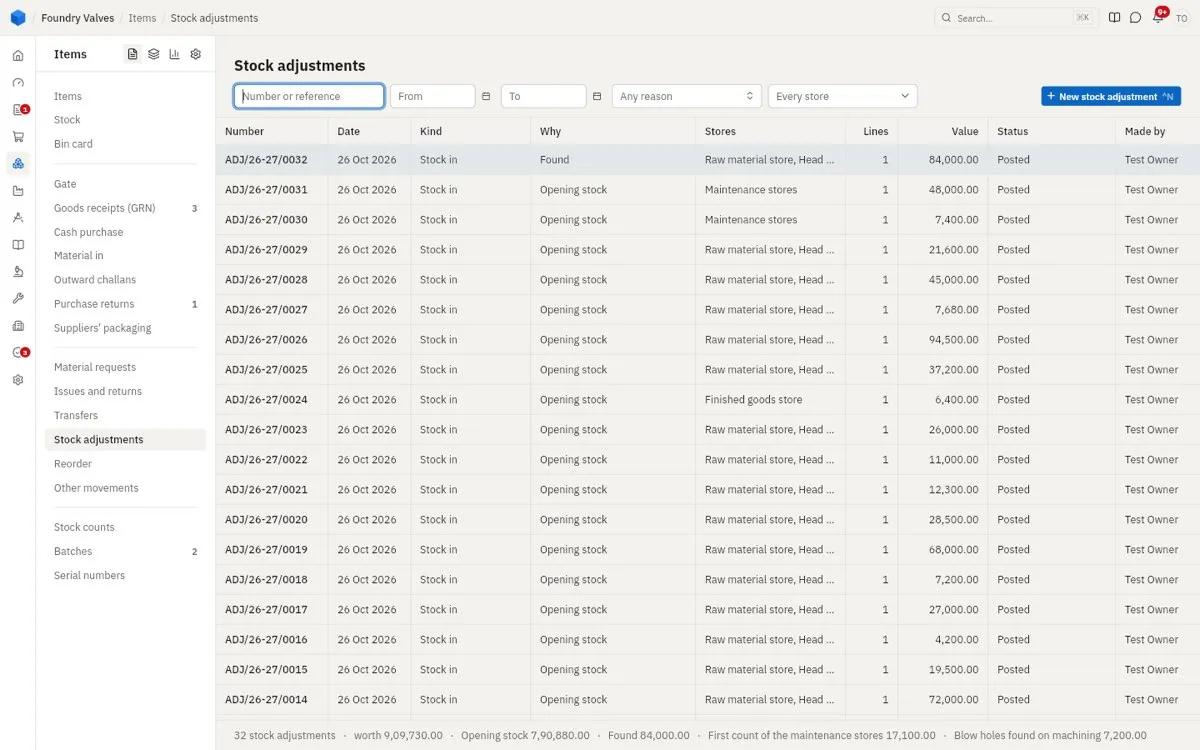
Reorder
What has fallen to its reorder level - counting what is free, under inspection and coming - ready to be bought or made. Empty means nothing is short.
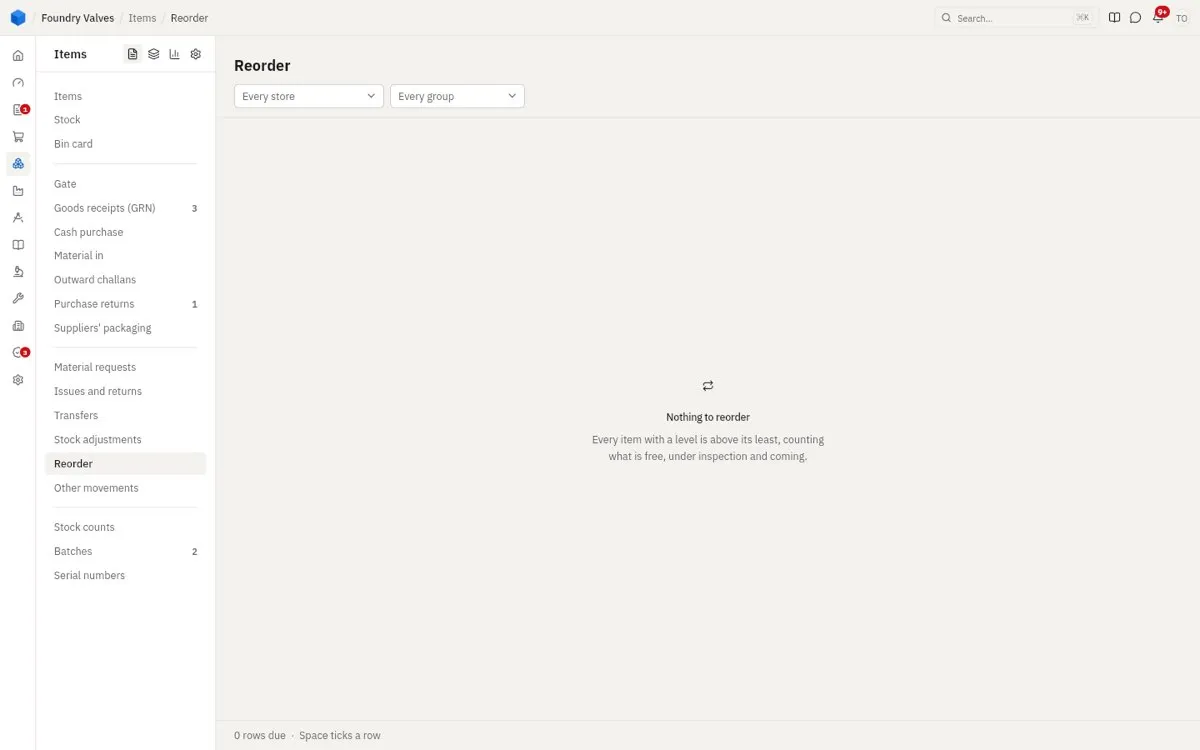
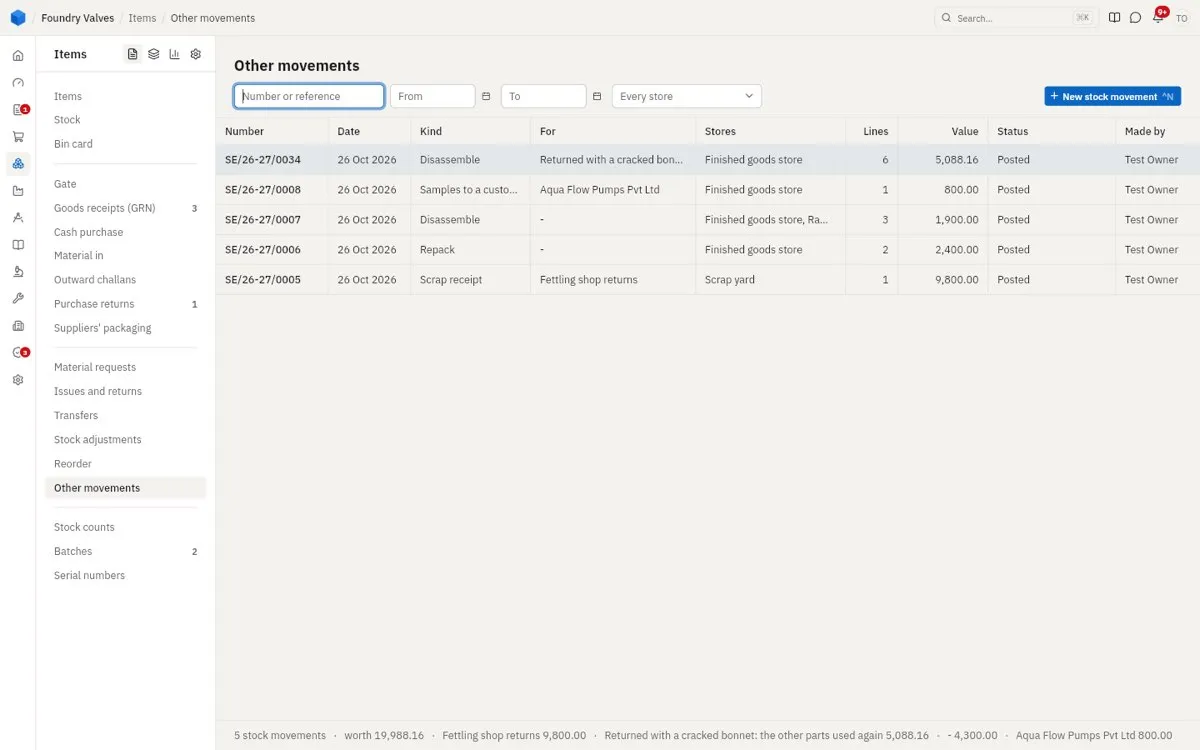
Other movements
The rest of what can happen to stock: repacked, taken apart (disassembled into its parts), scrapped, given as a sample.
Counts and tracking
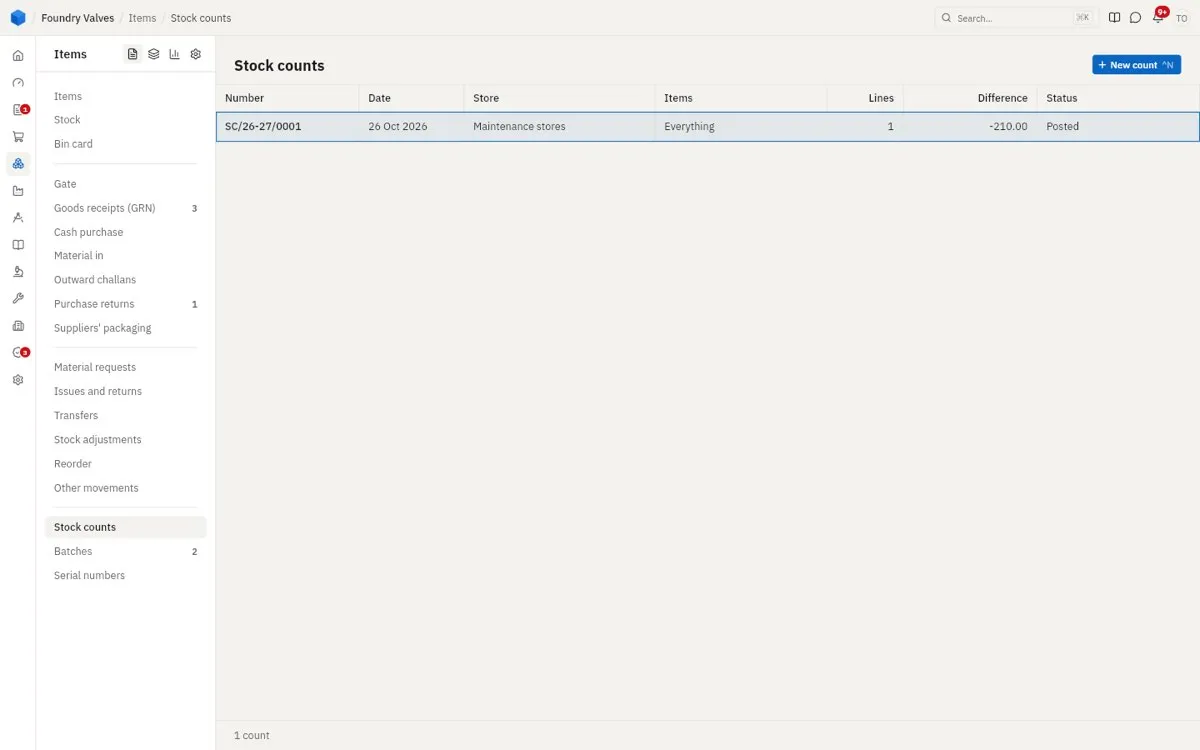
Stock counts
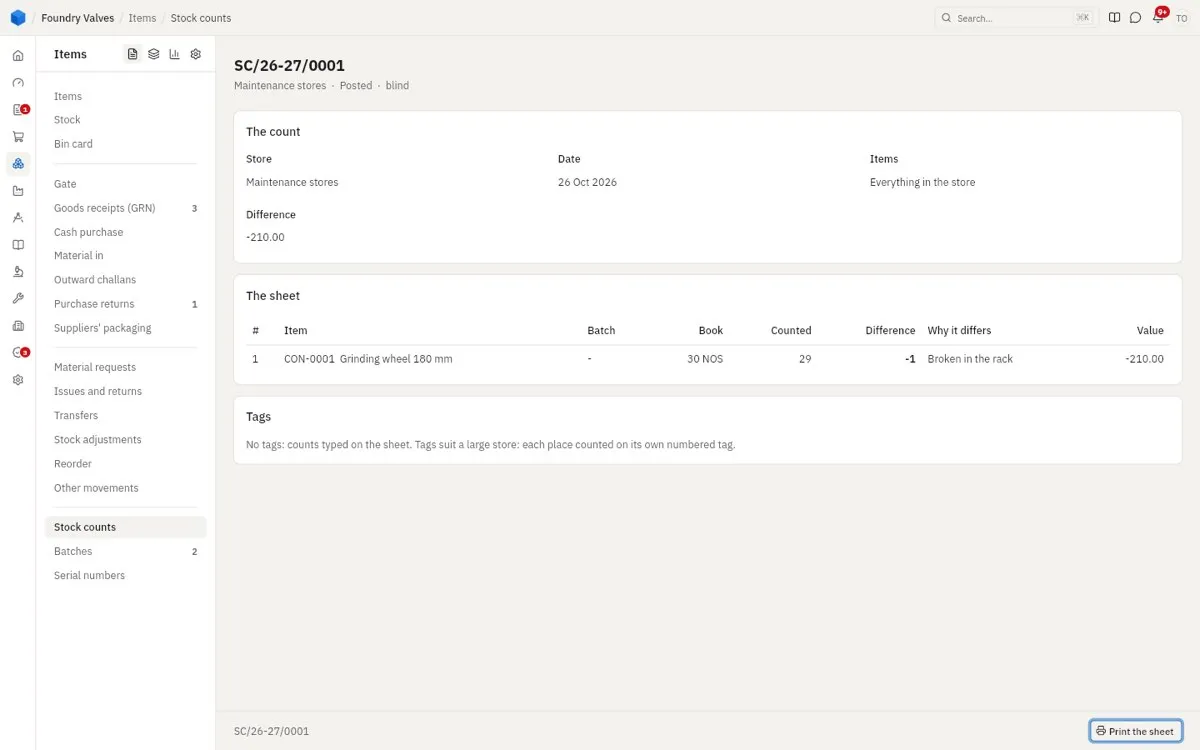
A count of a store against the books: the sheet, what was counted, and the difference with why. Posting it adjusts the stock.
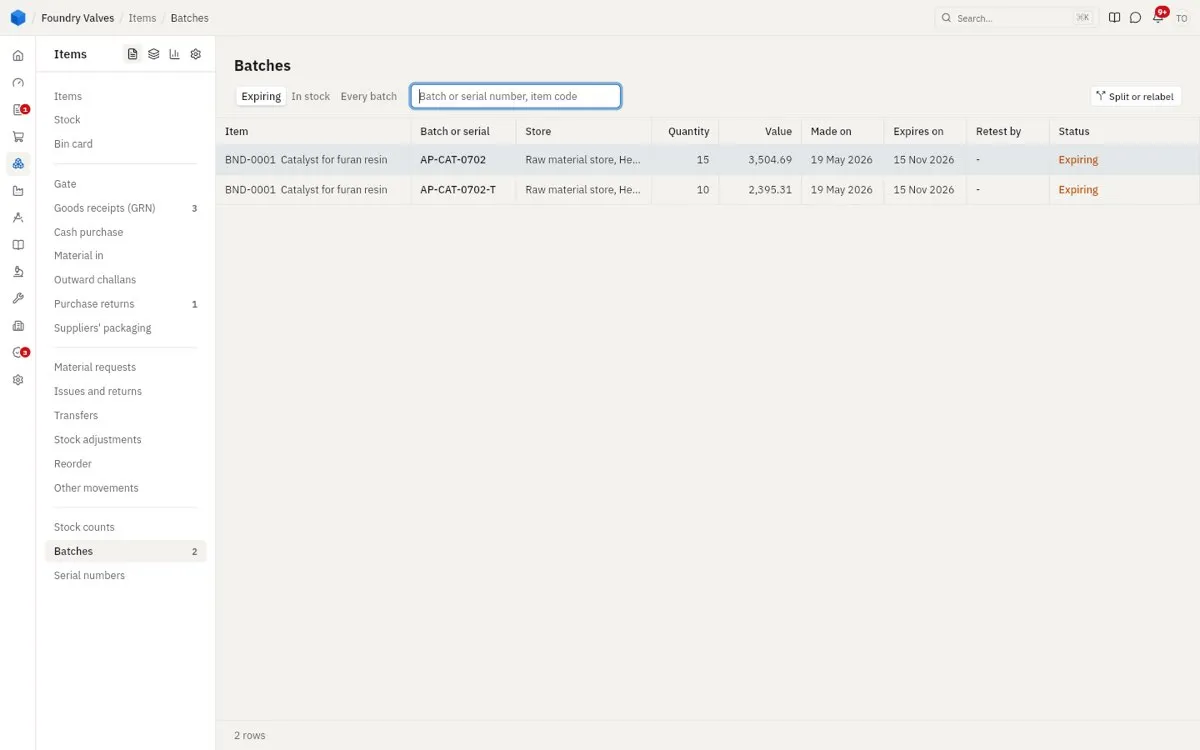
Batches
Every batch or lot (a heat of castings, a drum of resin) with its quantity, its dates, and when it expires or must be tested again. Expiring shows what runs out soon. Split or relabel divides a batch.
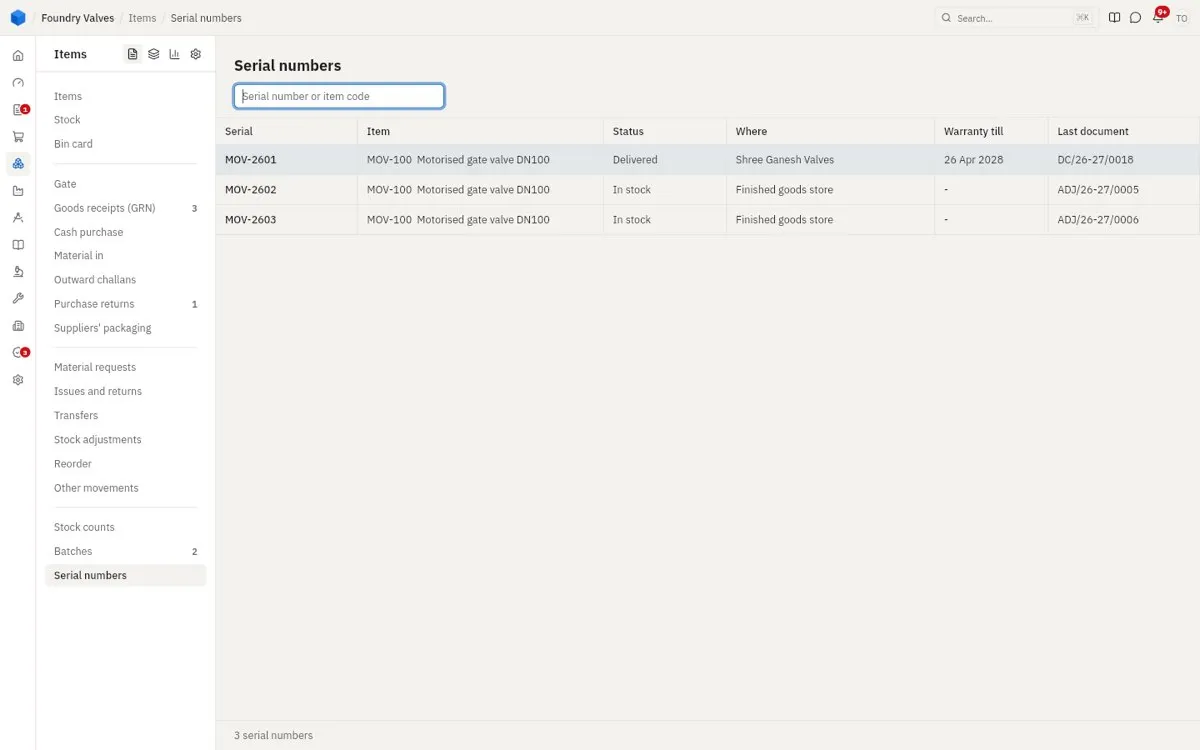
Serial numbers
Every serial-numbered piece: where it is now (a store, a customer), its warranty, and the last document that moved it.
Masters
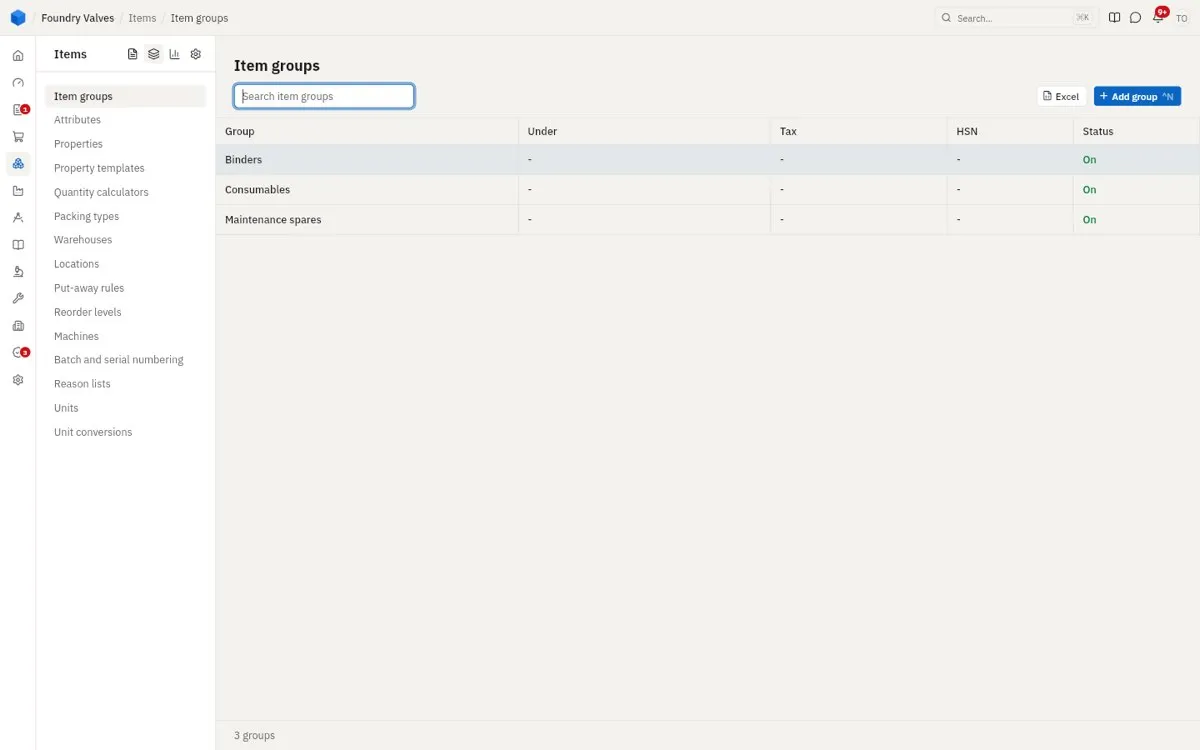
Item groups
Groups of items, one inside another, each able to carry its tax and HSN for the items in it.
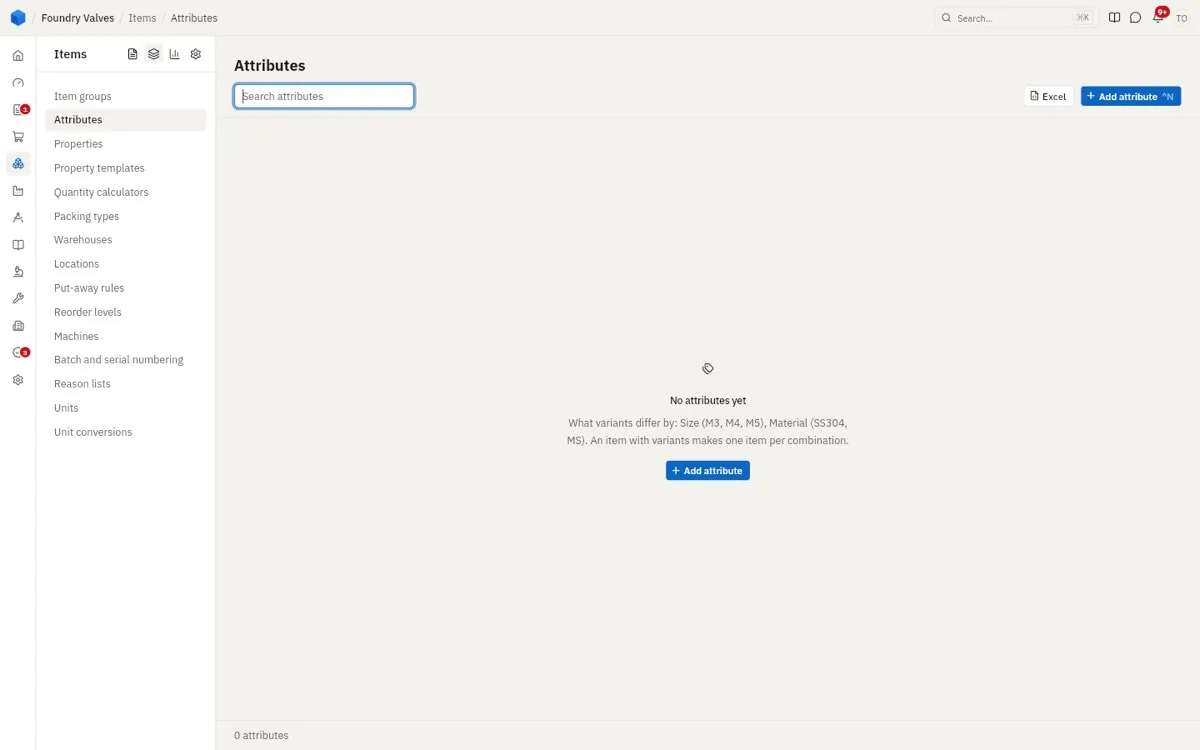
Attributes
What variants differ by - size, material - so one item with variants makes one item per combination.
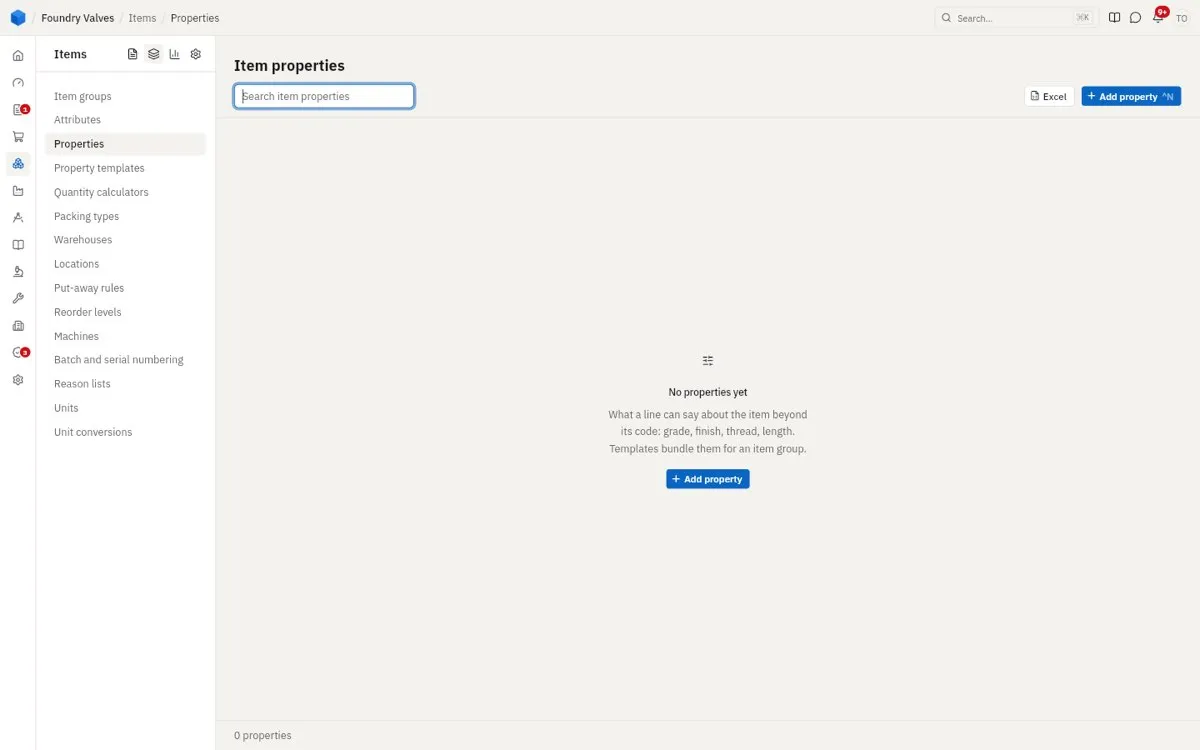
Properties
What a line can say about an item beyond its code: grade, finish, thread, length.
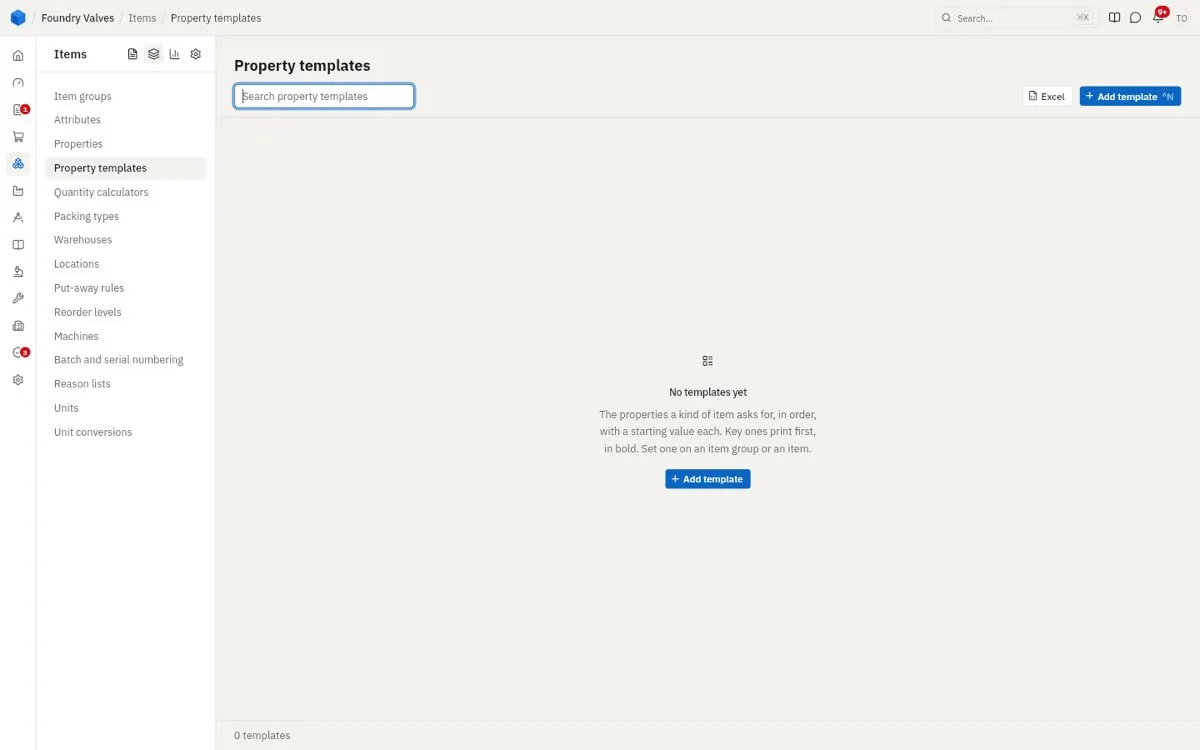
Property templates
The properties a kind of item asks for, in order, with a starting value each - set on an item group or an item.
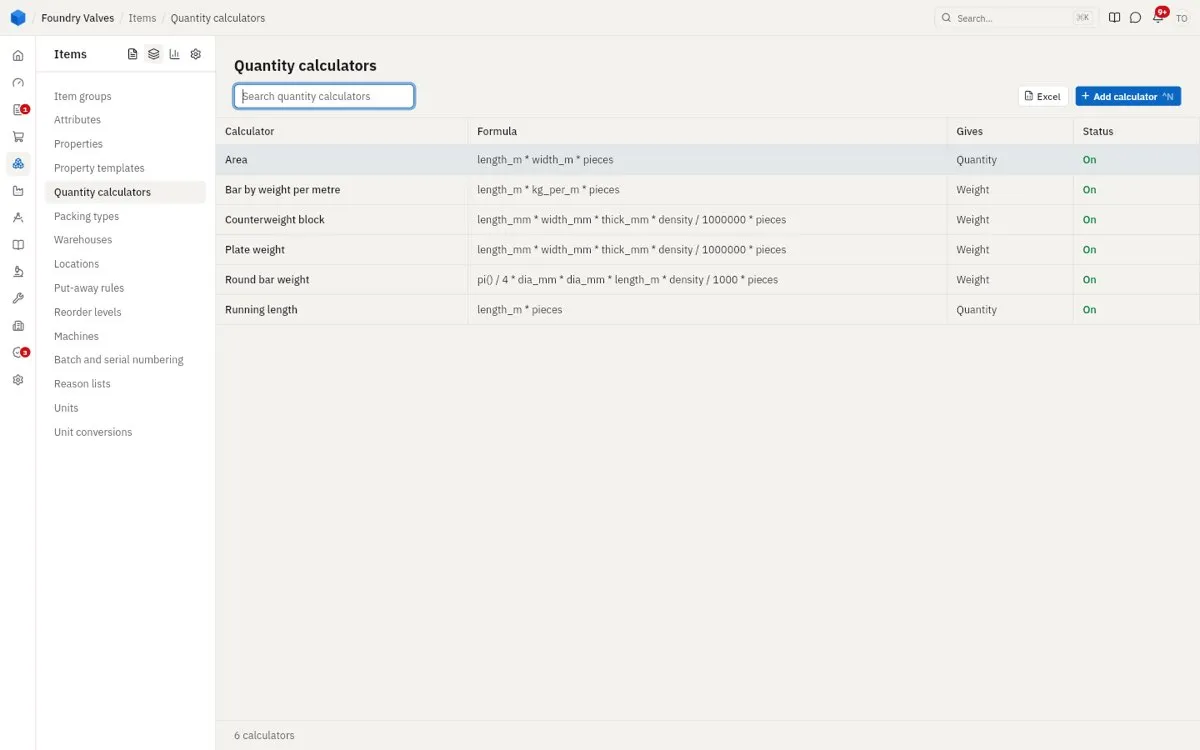
Quantity calculators
Formulas that work out a quantity from its sizes: a plate's weight from length, width, thickness and density; a running length from pieces.
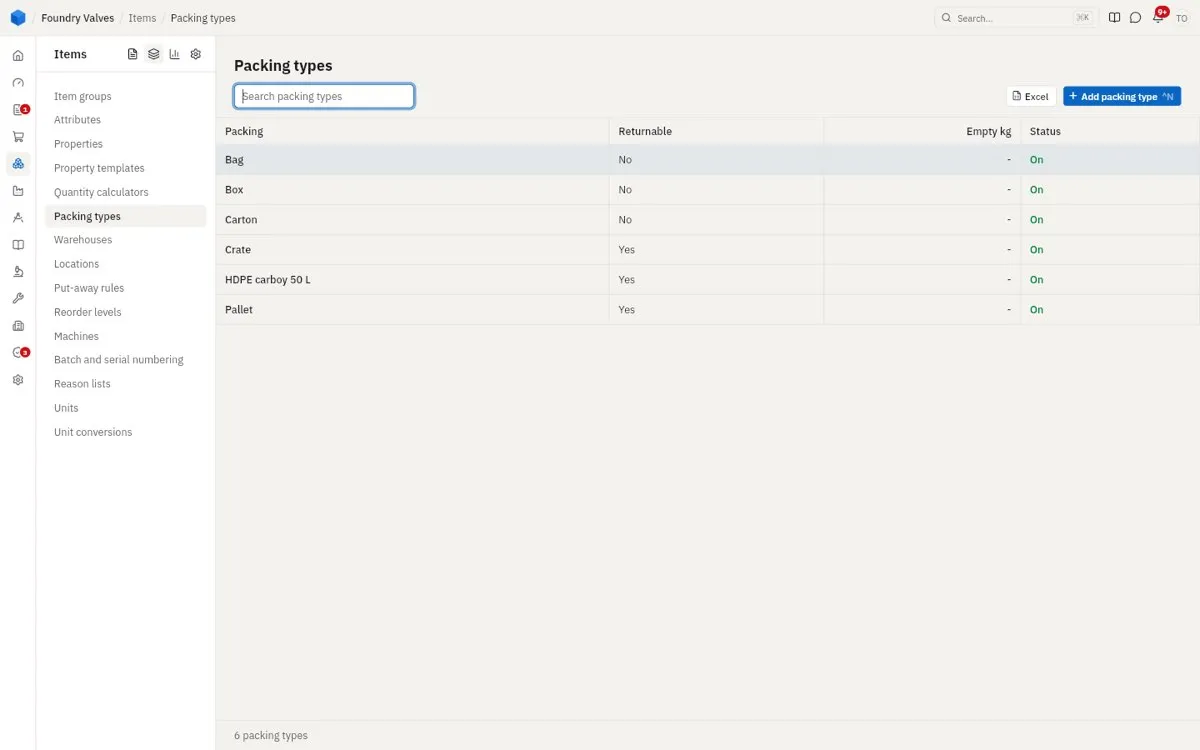
Packing types
Bag, box, crate, pallet - and whether each is returnable.
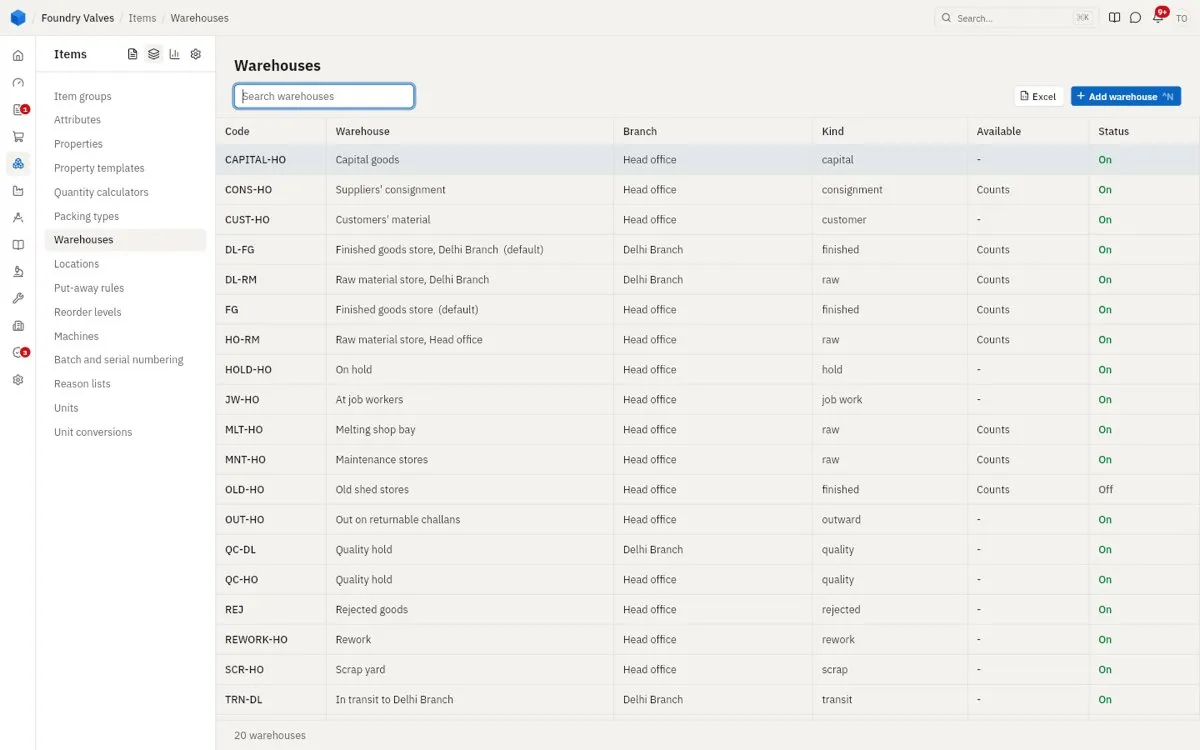
Warehouses
Every store, by plant, and its kind: raw material, finished goods, quality hold, rejected, rework, scrap, at job workers, in transit, customers' material. Counts means its stock counts as available.
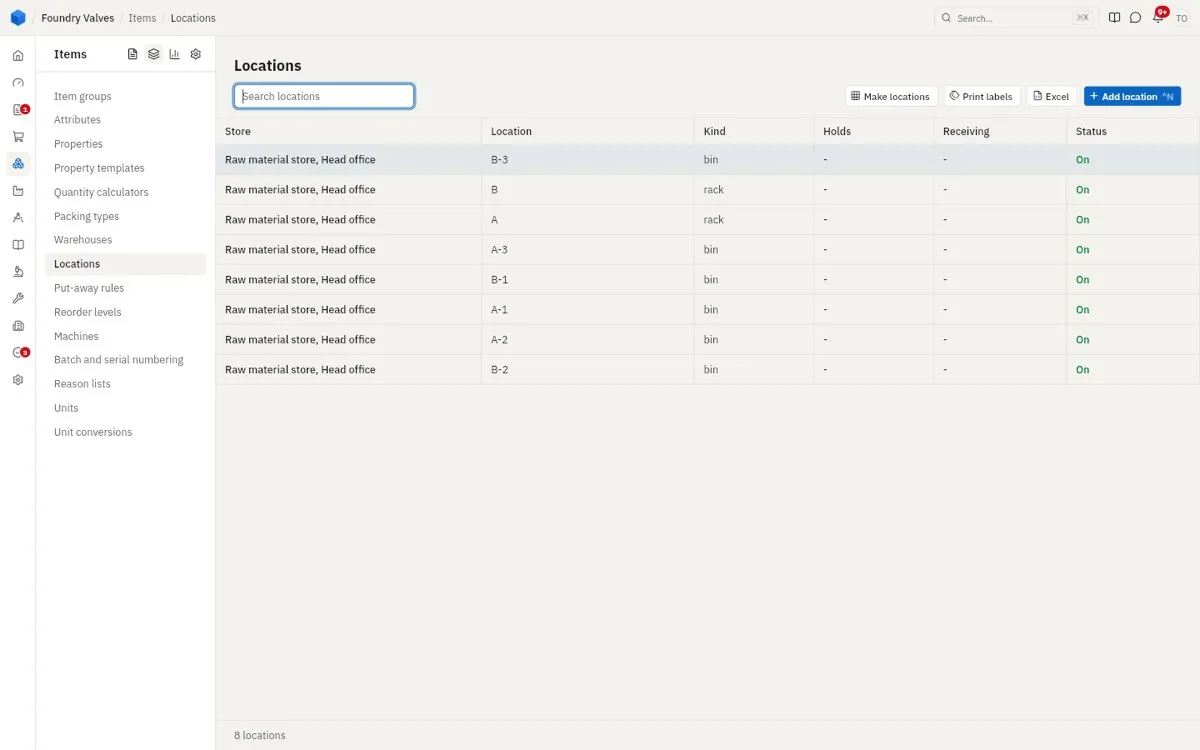
Locations
Racks and bins inside a store, so stock can be found. Make locations makes a row of them; Print labels prints their tags.
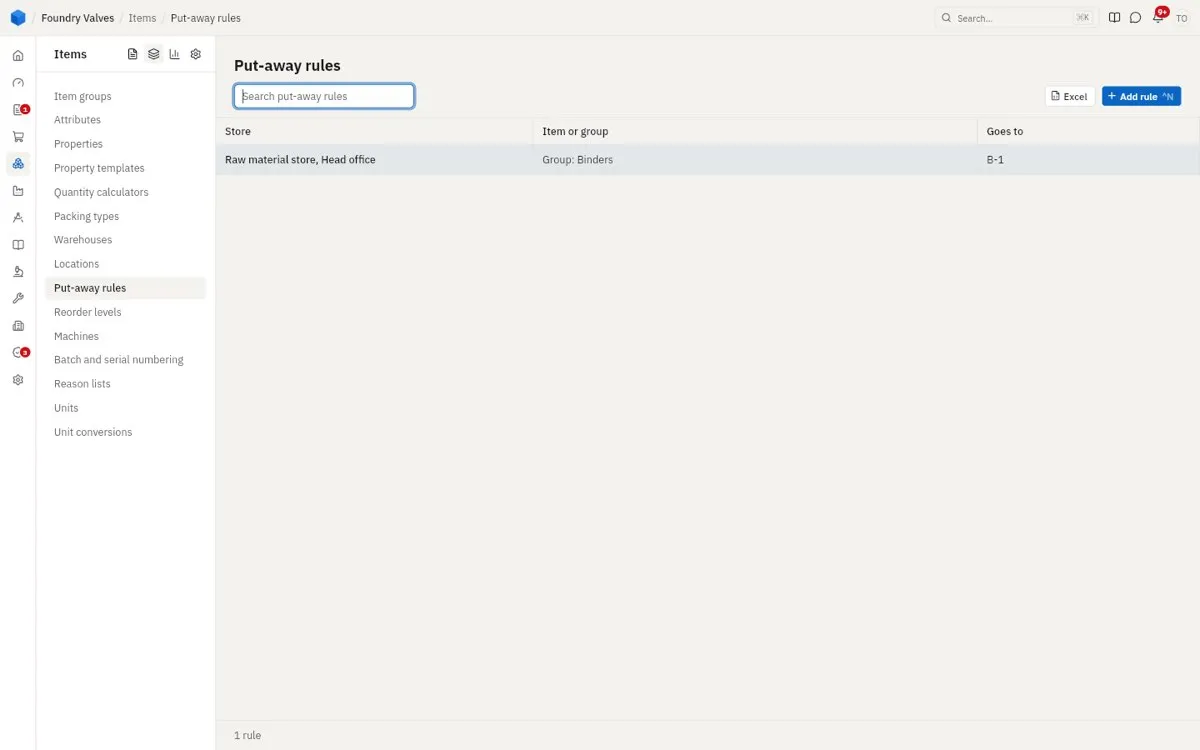
Put-away rules
Where received goods of an item or group go inside a store (binders to rack B-1).
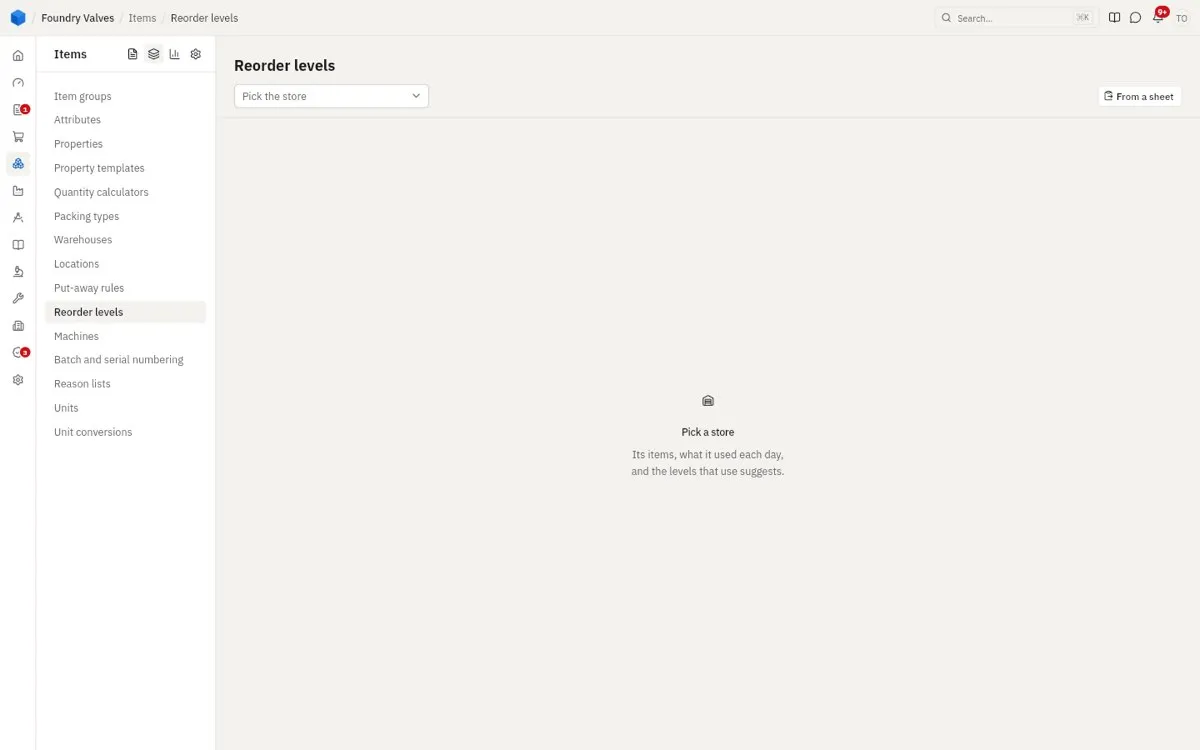
Reorder levels
For each item in a store, the level to reorder at and how much - suggested from what it used each day.
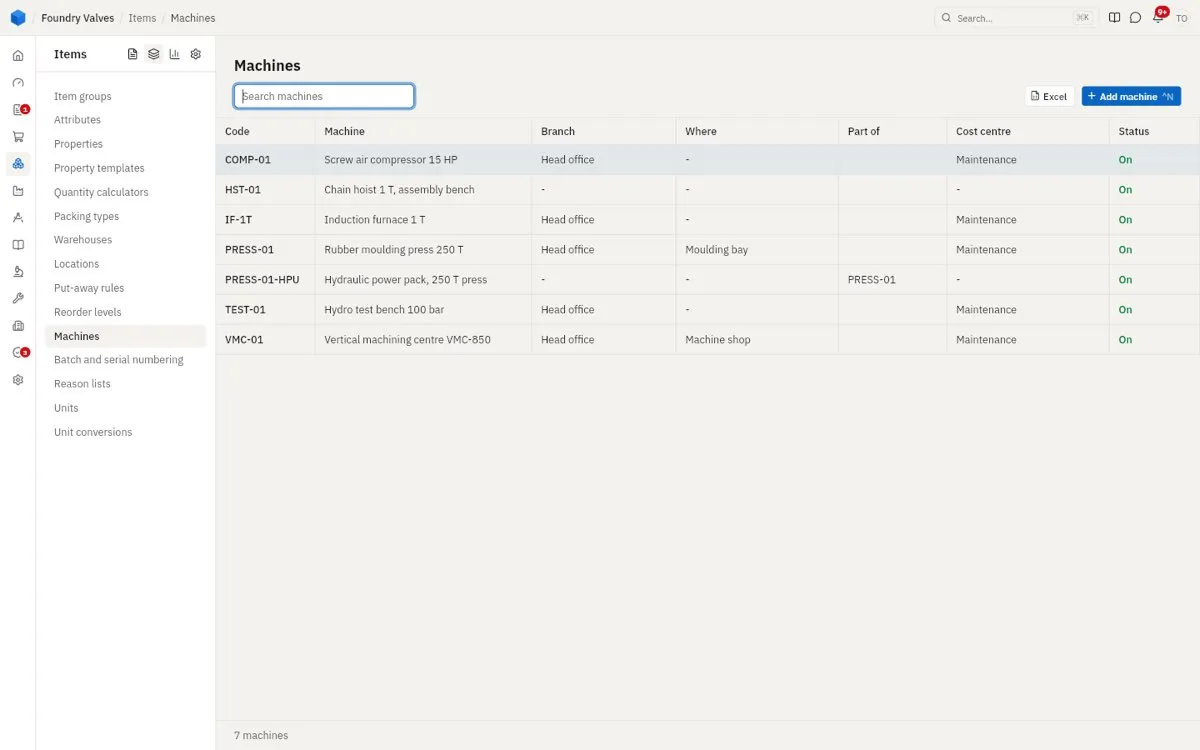
Machines
The plant's machines, where each stands and its cost centre - issues to a machine land on it, and Maintenance looks after them.
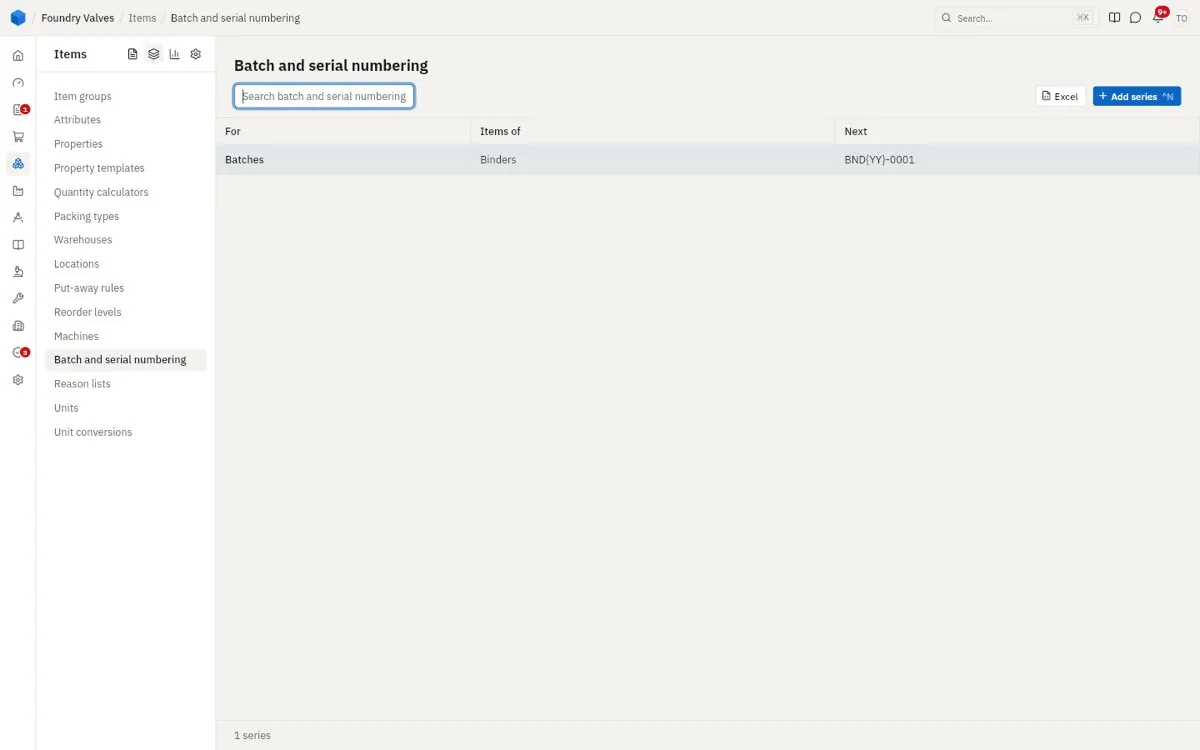
Batch and serial numbering
How new batch and serial numbers are made for a group of items (BND(YY)-0001).
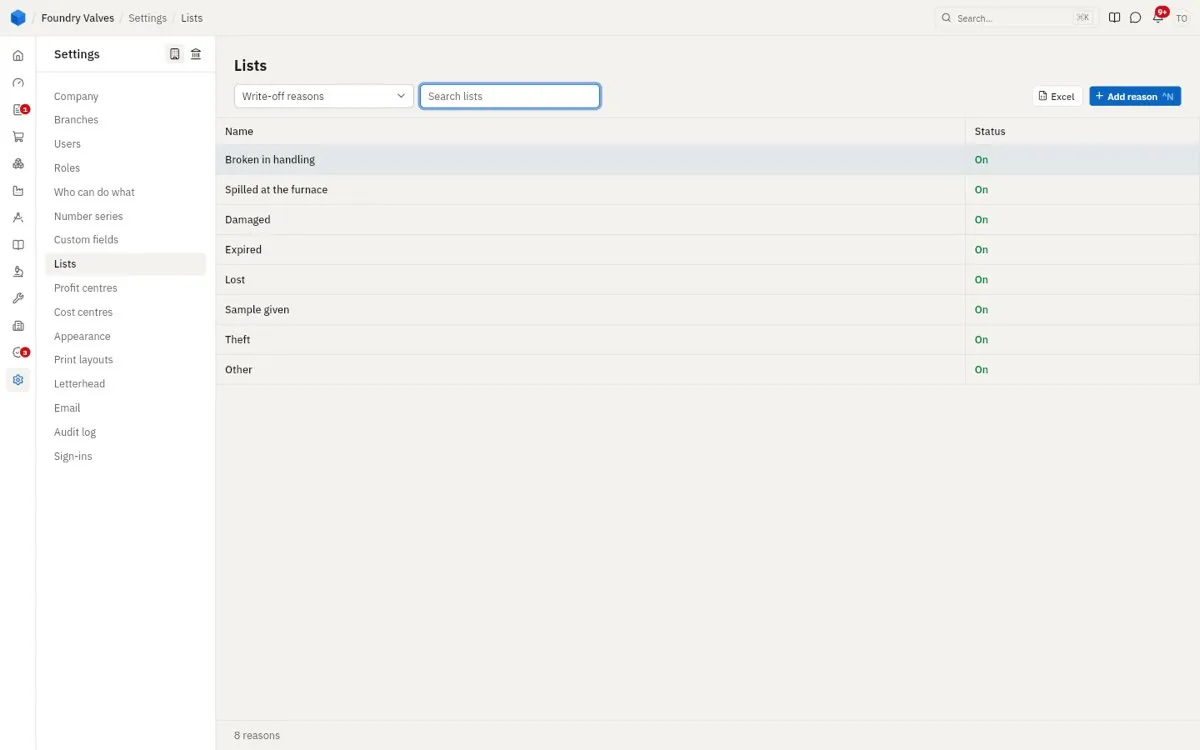
Reason lists
The reasons a stock adjustment can give - broken in handling, expired, theft - so they are the same everywhere.
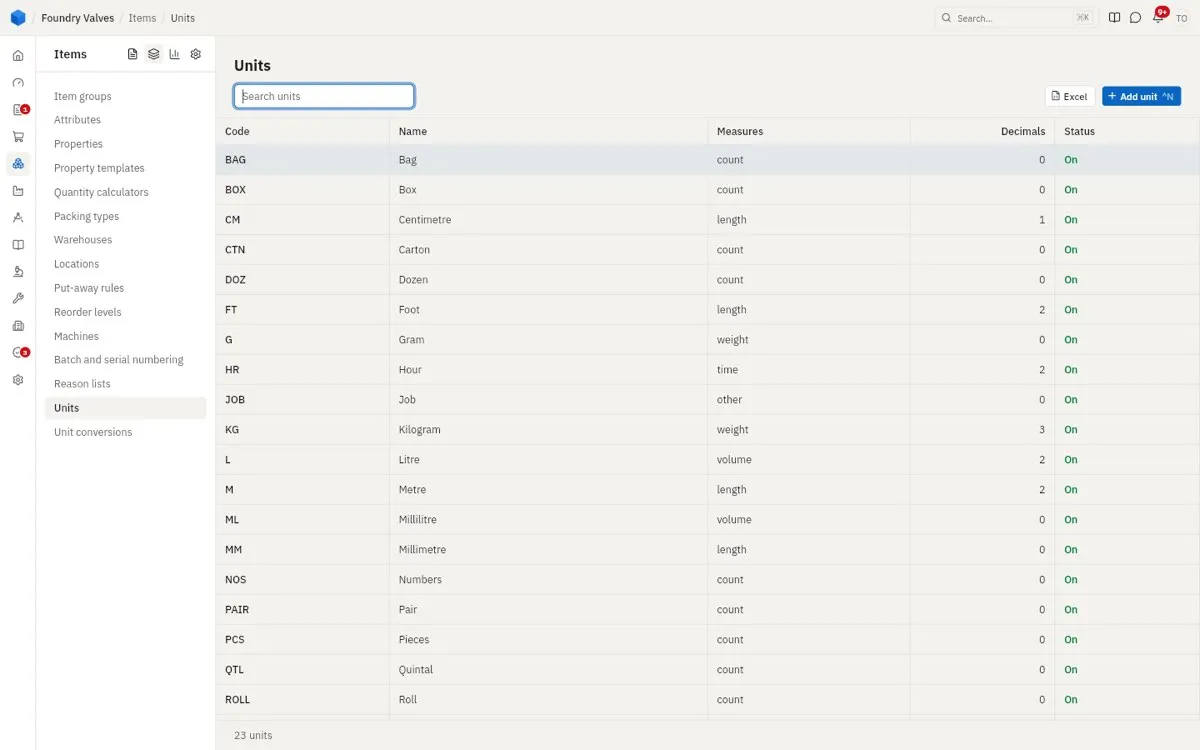
Units
Units of measure (NOS, KG, M, SET...) and how many decimals each takes.
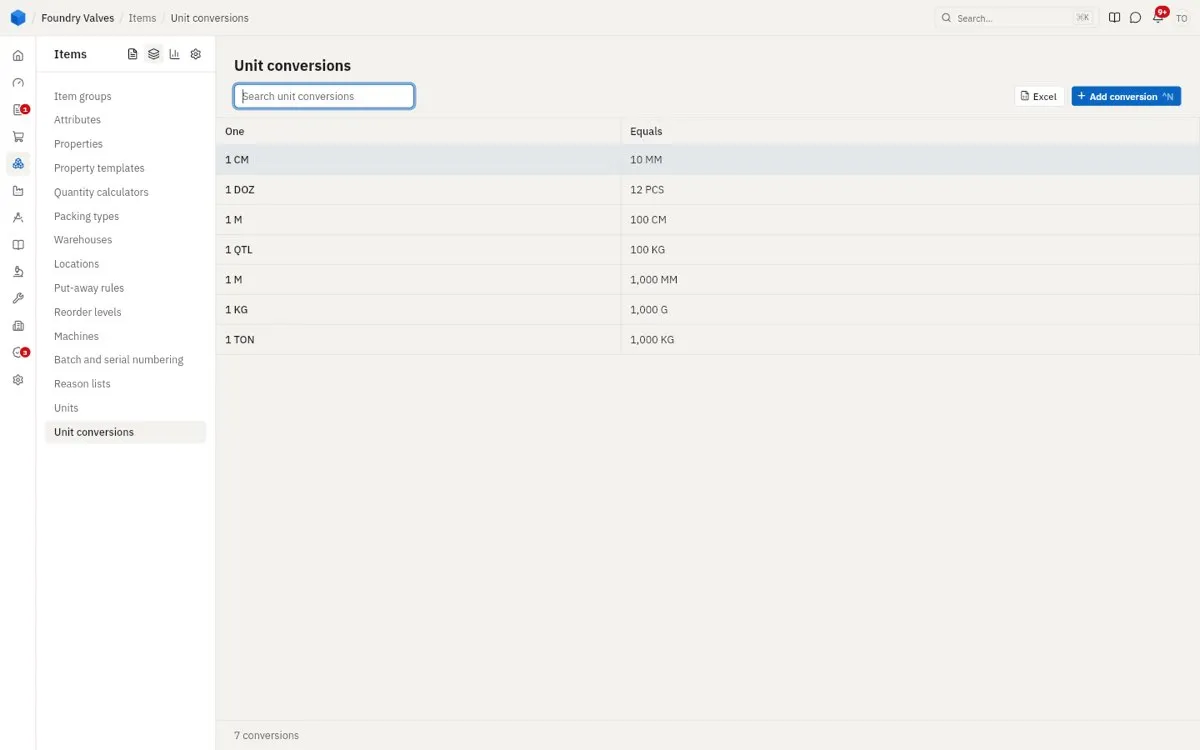
Unit conversions
How units turn into each other (1 KG = 1,000 G; 1 DOZ = 12 PCS), for every item.
Reports
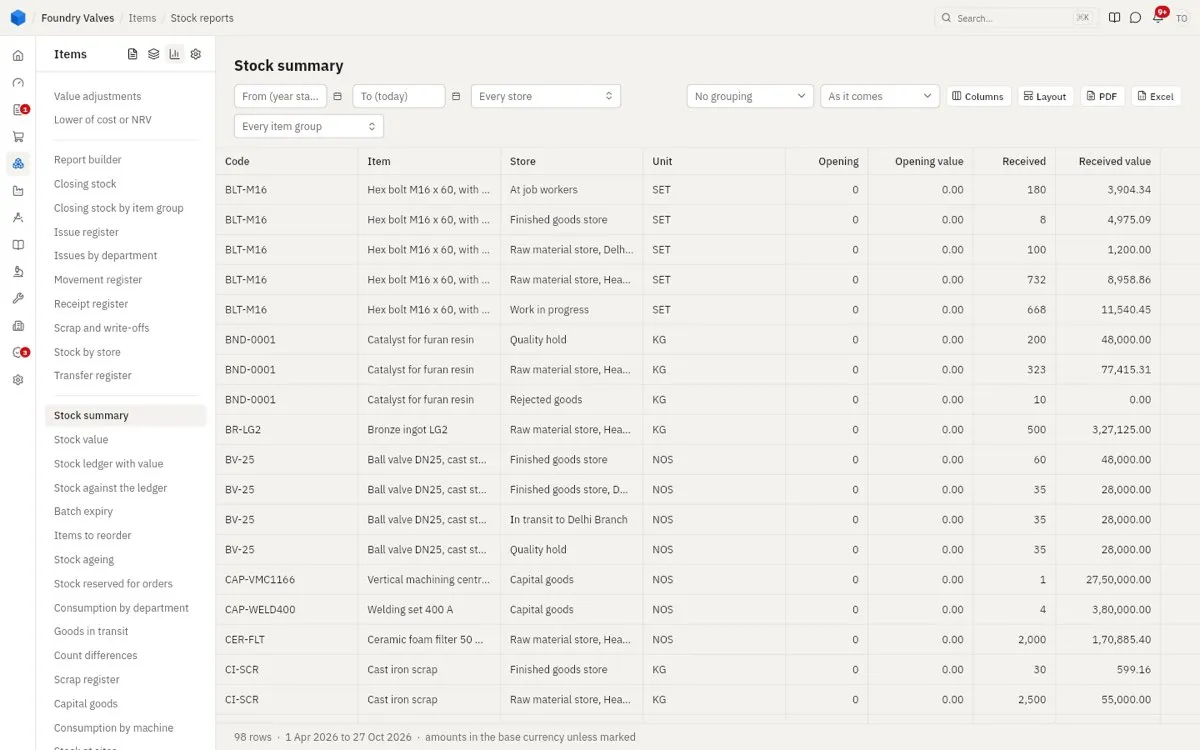
Stock reports
Every stores report, down the left: the stock summary (opening, received, issued, closing, with value), closing stock, the issue and receipt registers, stock by store, ageing, batch expiry, items to reorder, consumption by department and machine, and more.
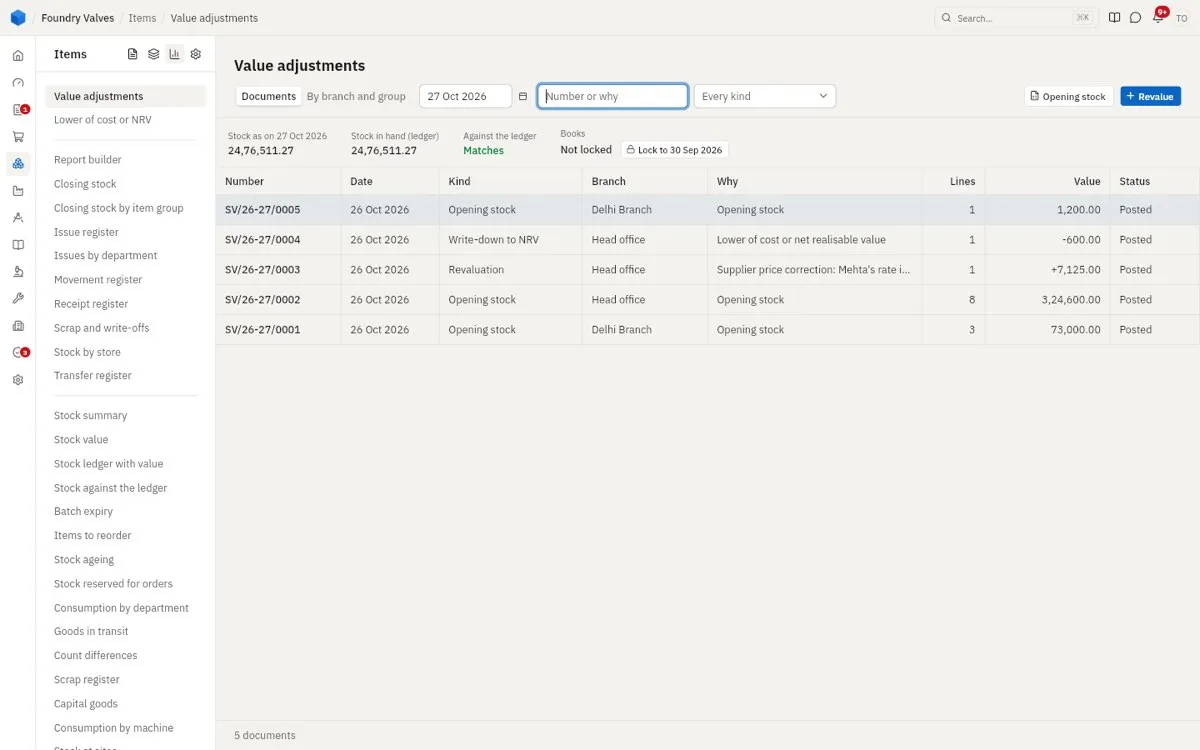
Value adjustments
Changes to what stock is worth without it moving: opening stock, a revaluation, a write-down. The top shows the stock value against the ledger, and Lock to closes a month so nobody posts into it.
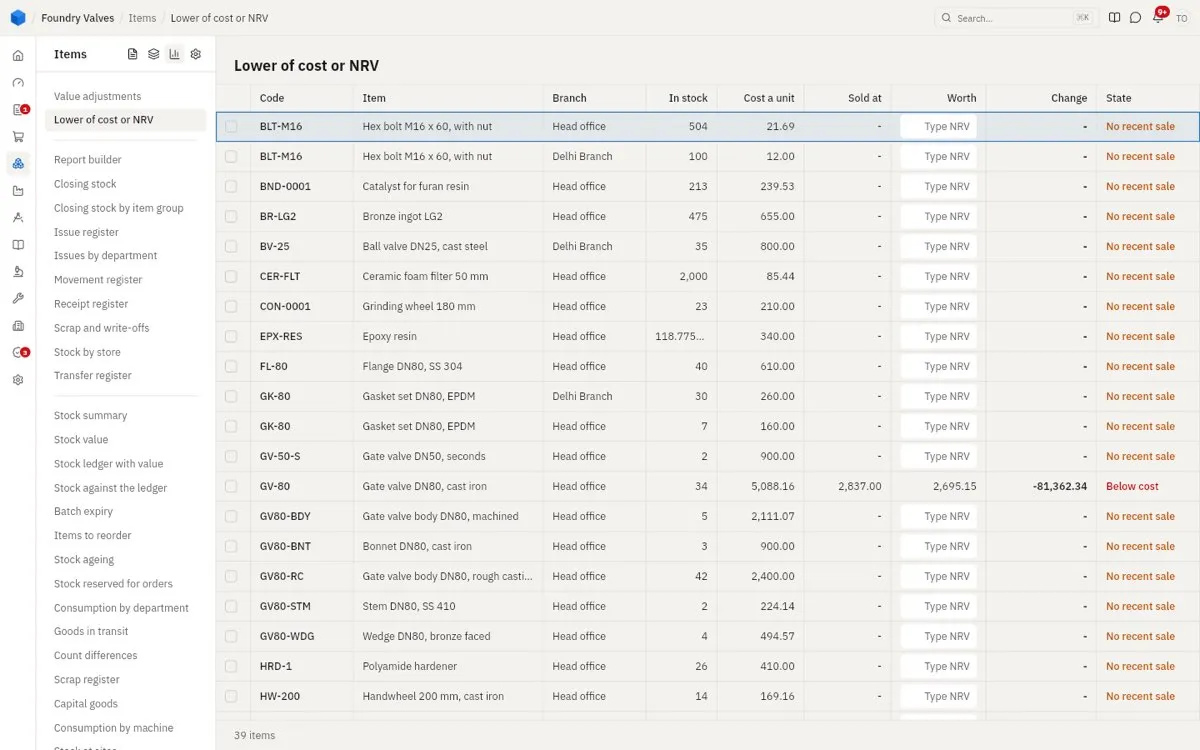
Lower of cost or NRV
Each item's cost against what it would sell for now (net realisable value). One worth less than it cost is written down - the accounting rule for valuing stock.
Settings
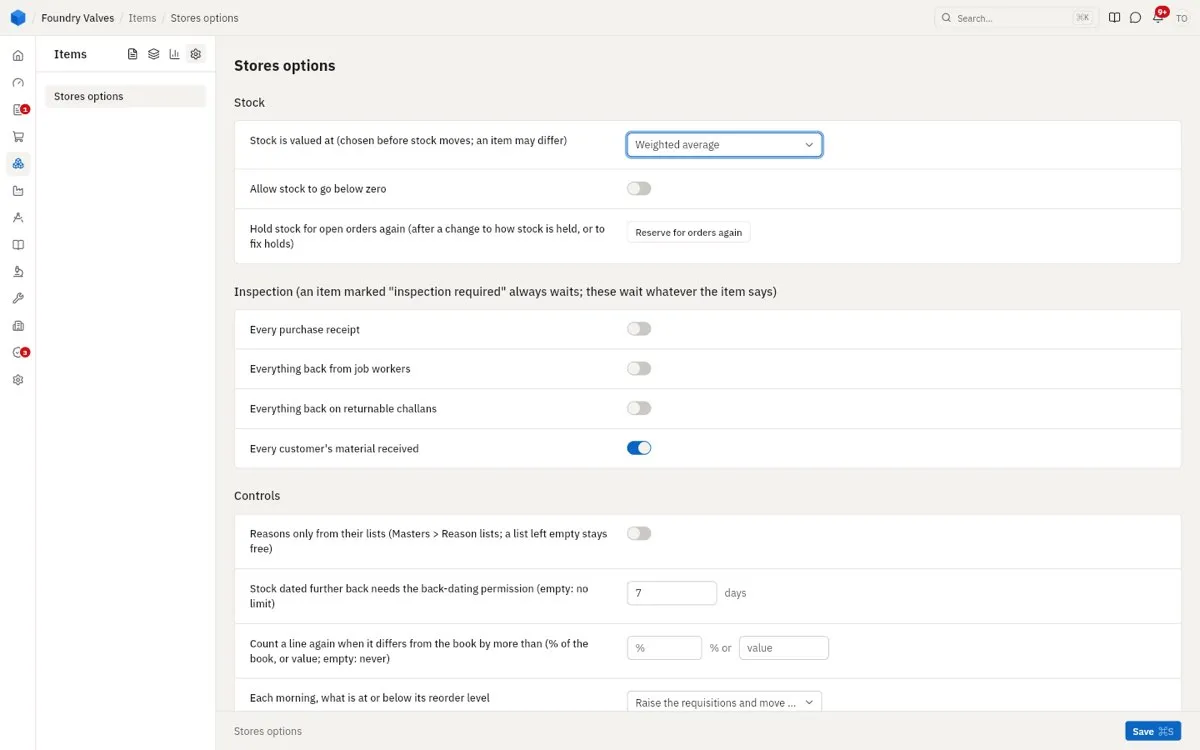
Stores options
How stock is valued (weighted average or FIFO), whether stock may go below zero, what always waits for inspection, how far back a movement may be dated, when a count line must be counted again, and what to do each morning with what is below its reorder level.
The main records, tab by tab
Item
On top: how much is on hand, free and coming, and in how many stores; Movements opens its bin card. At the foot: History, Copy, Delete (only while nothing has used it), Save. Tabs:
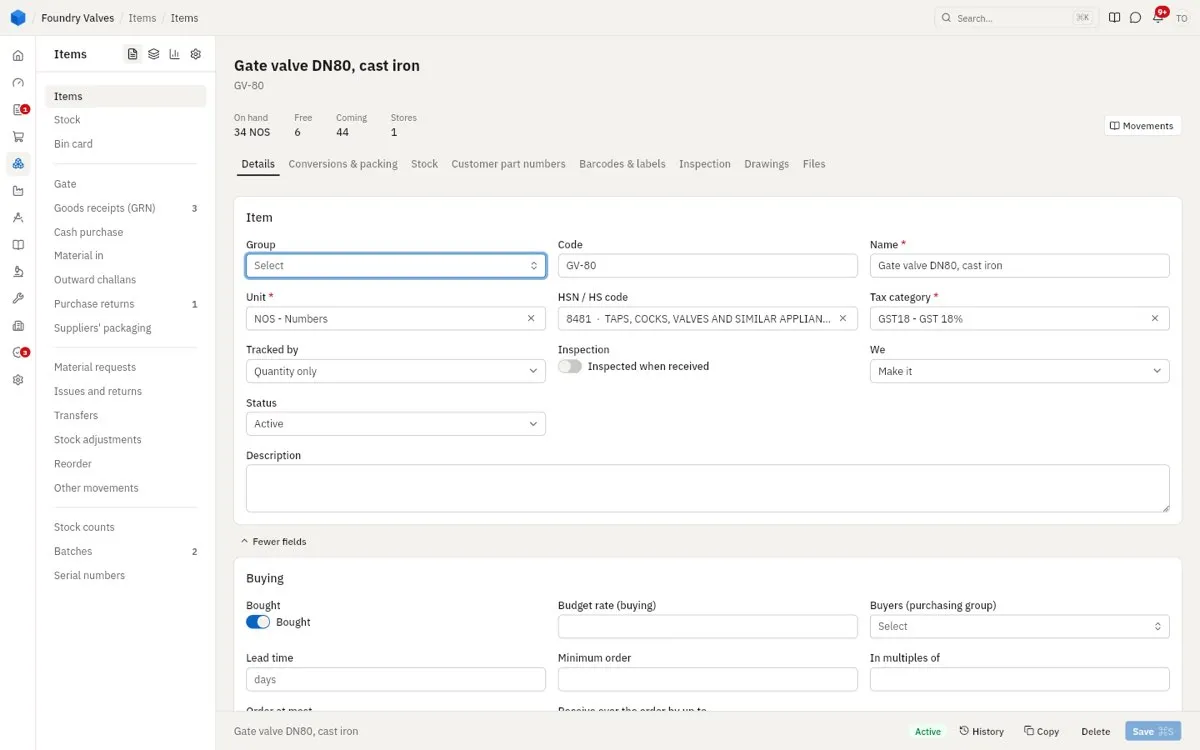
- Details: group, code, name, unit, HSN, tax, tracked by (quantity, batch or serial), inspected when received, made or bought; then buying, selling and stock fields
- Conversions & packing: its own units and how it is packed
- Stock: each store's stock, the projected stock ahead, its default stores per plant, and the items that can stand in for it
- Customer part numbers: what each customer calls it
- Barcodes & labels: the barcodes on its packing, and its label to print
- Inspection: how it is checked when received and before dispatch, and the readings to take
- Drawings and Files: its drawing, specification and papers
Goods receipt
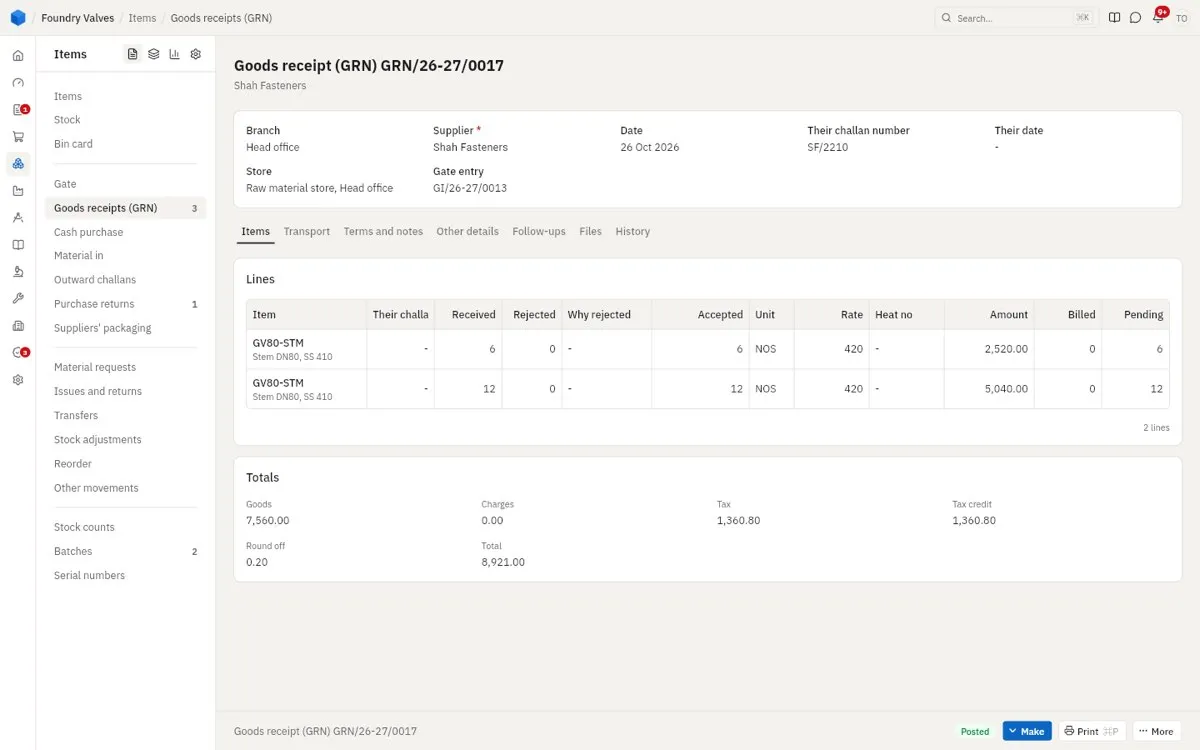
The supplier, their challan and date, the store and the gate entry up top. Each line: received, rejected (and why), accepted, its rate, its batch or heat number and its serials, and how much is billed. At its foot, Make the invoice from it. Tabs: Items · Transport (their invoice, e-way bill, vehicle, LR) · Terms and notes · Other details · Follow-ups · Files · History
Purchase return
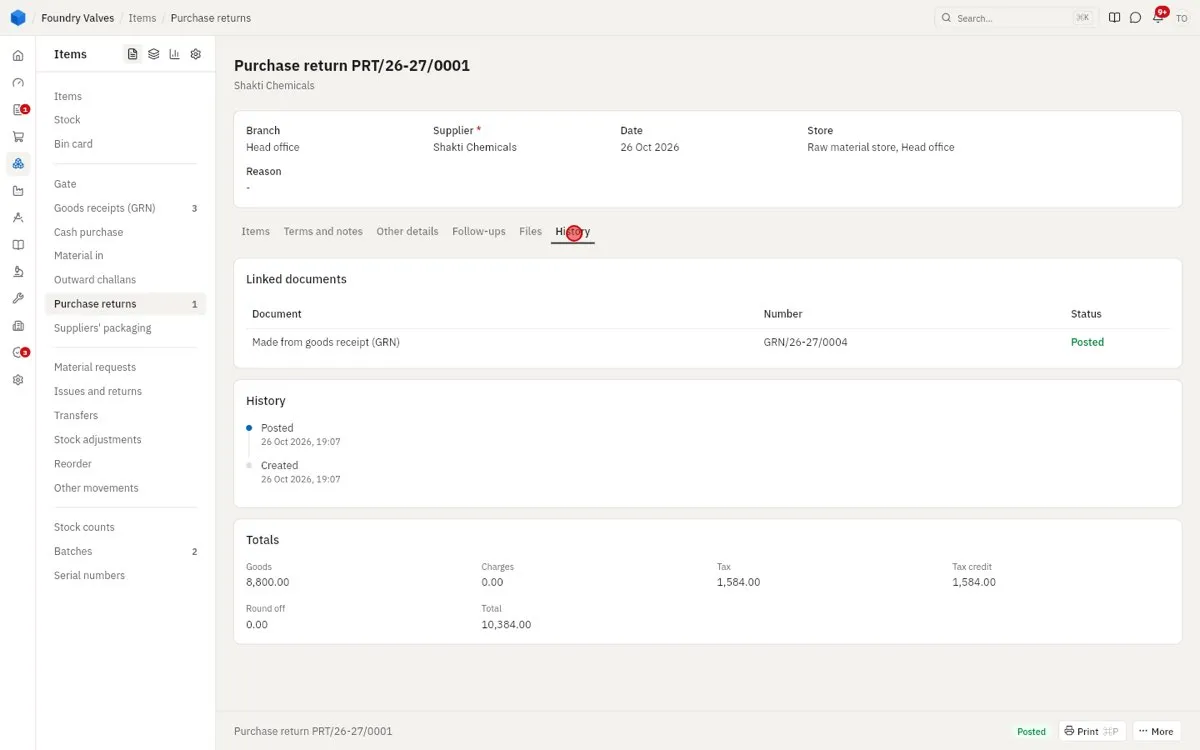
What goes back to the supplier and from which store, against the receipt it came on. Its History shows the receipt and the debit note.
Outward challan
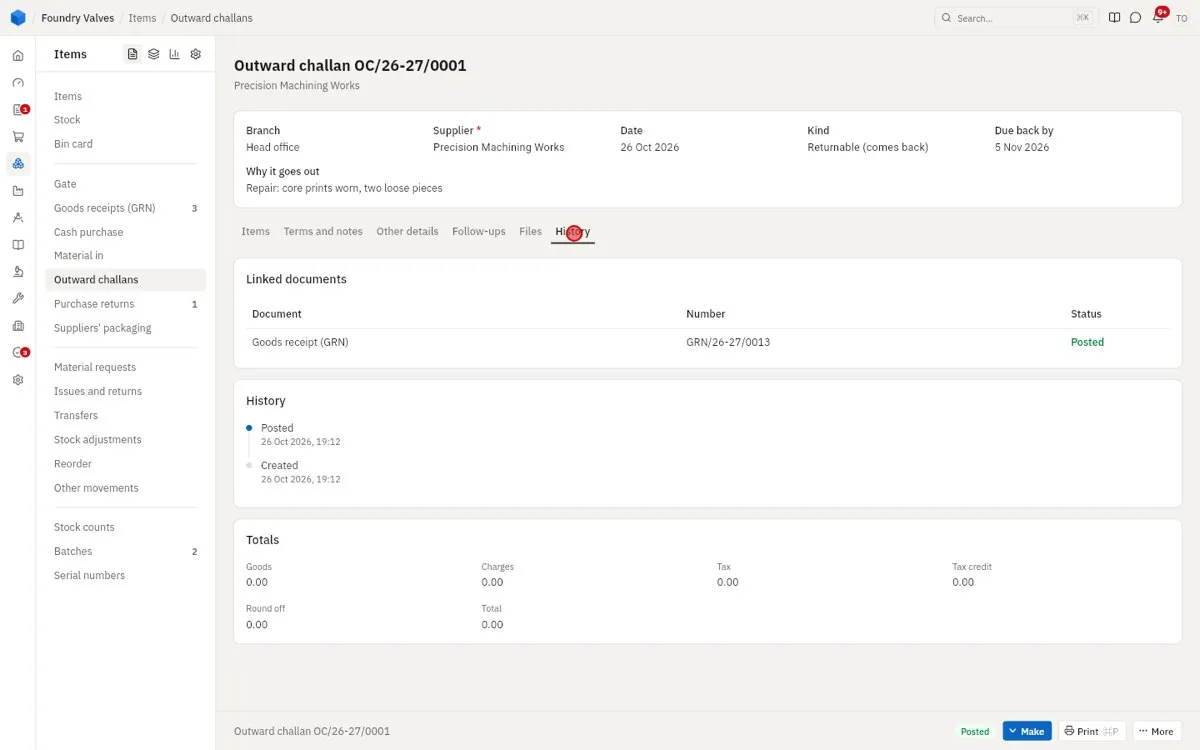
What went out, to whom, why, and whether it must come back. Its History shows what has returned.
Material request
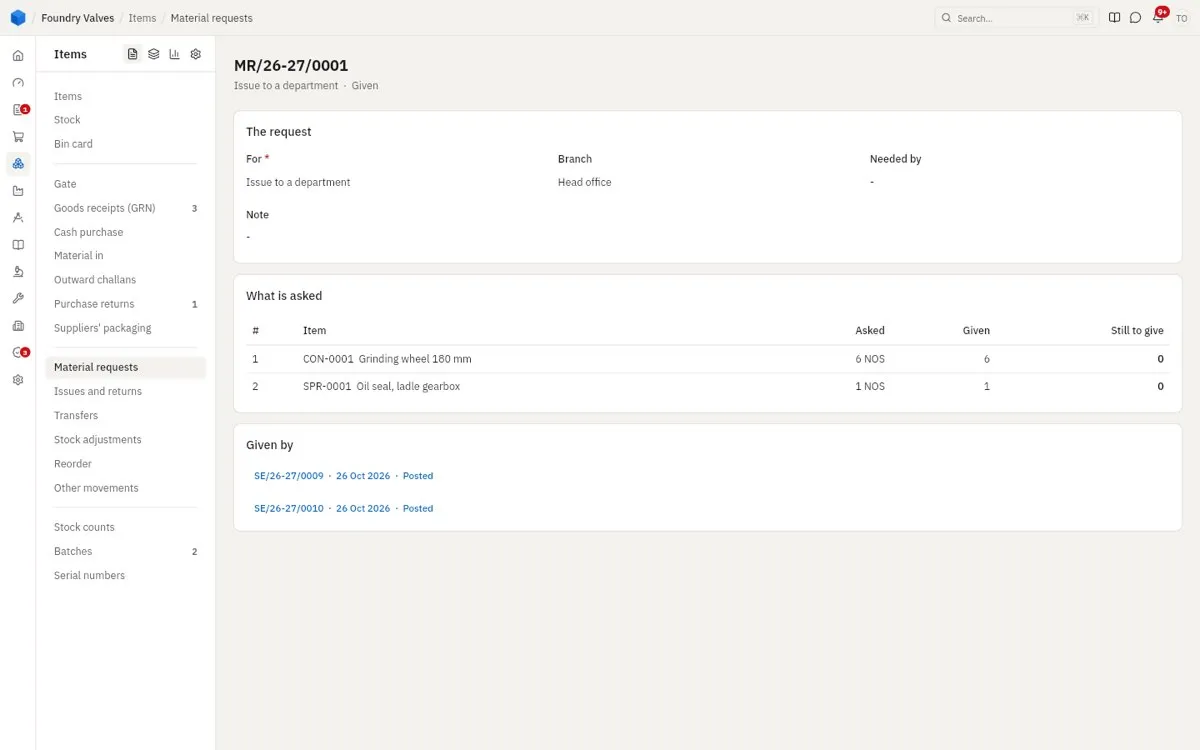
Who asks, for what, how many, by when - and what the stores have given against it.
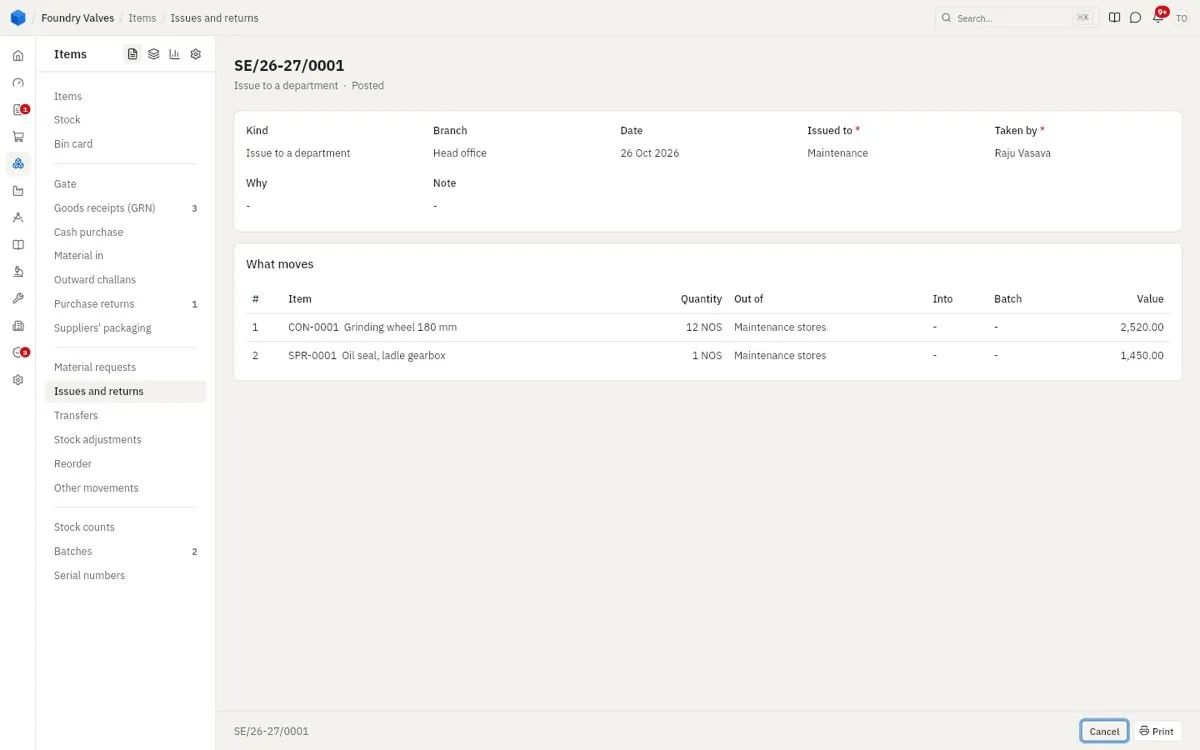
Issue
The kind (issue or return), who it went to and who took it, then What moves: each item, how many, out of which store, its batch, its value. Cancel puts it back.
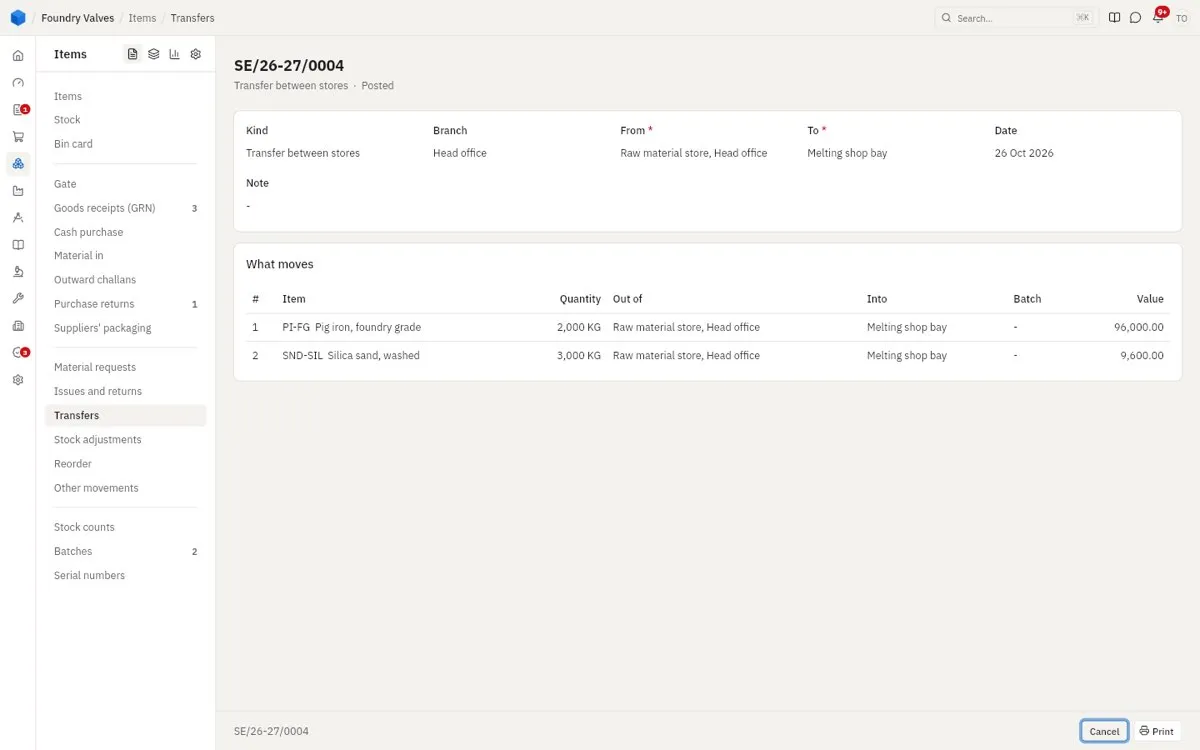
Transfer
From one store to another: each item, how many, from where and into where.
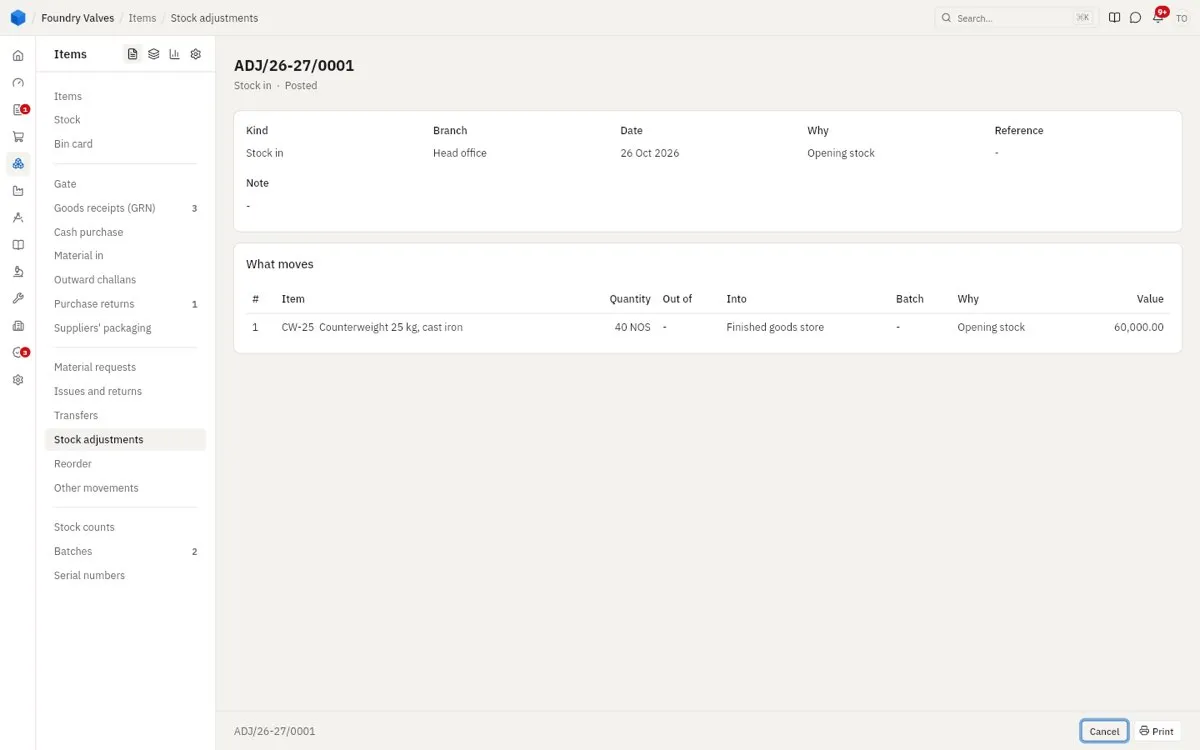
Stock adjustment
Stock in or out with the reason for each line.
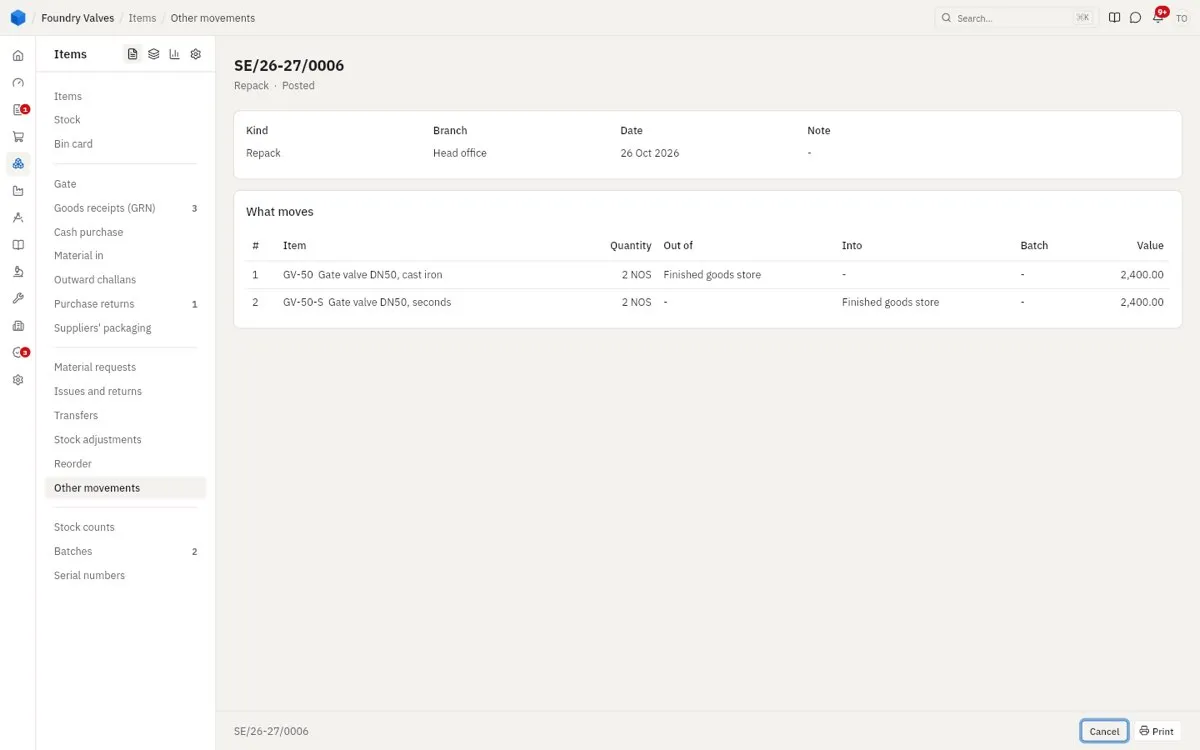
Other movement
A repack, a disassembly or a scrap receipt: what went out of stock and what came in for it.
Stock count
The store and what was counted, then The sheet: each item's book quantity, what was counted, the difference and why it differs. A blind count hides the book figures from the counter. Print the sheet prints it to count on.